Goat Feeders
Goats are messy and surprisingly picky eaters, so the feeder we choose can affect much more than keeping the barn tidy.
We’ve seen how quickly good hay can end up underfoot when goats pull it from the wrong type of feeder, and once it is dirty or trampled, they often leave it behind. That means more wasted feed, more money spent, and a feeding area that gets dirty fast.
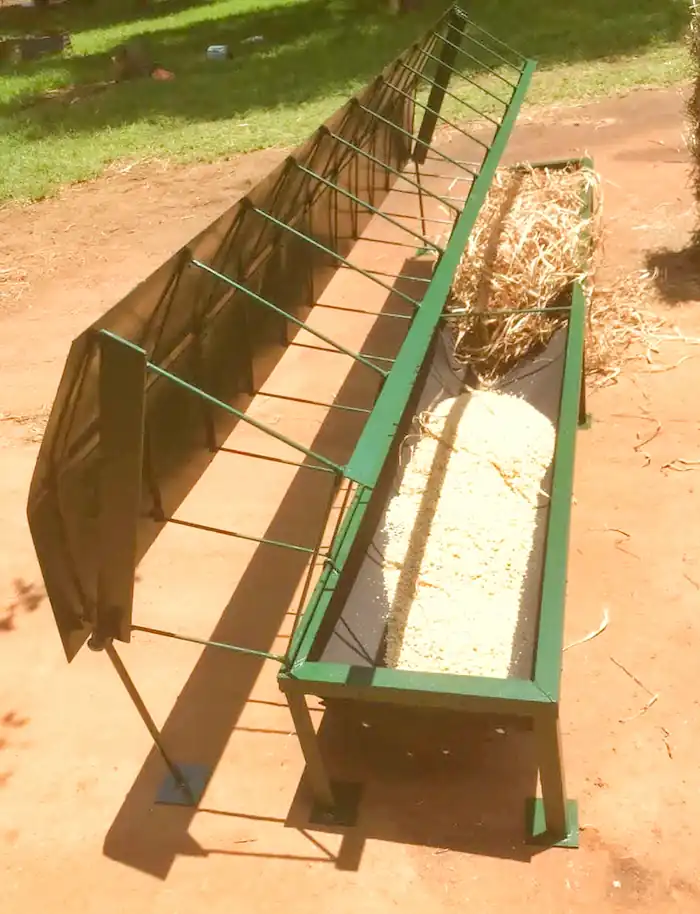
Our goat feeders need to keep hay and other feeds at a comfortable height while making it difficult for goats to climb, spill, or pull everything onto the ground.
The right setup also depends on what we’re feeding, how many goats we have, their size, and whether they have horns.
If you’re still working out the basics of what goats eat, that will also help you decide which type of feeder fits your feeding routine.
From simple homemade hay feeders to metal, hanging, pellet, grain, and automatic options, there are plenty of ways to set up a cleaner and less wasteful feeding system.
8 Best Goat Feeders for Hay, Grain, Minerals & Pellets
1. TEXOTZAN 70-Gallon 2-in-1 Goat Hay & Grain Feeder
| Key feature | Details |
| Feeder type | Hay + grain/pellet feeder |
| Capacity | 70 gallons total |
| Hay section | 45-gallon upper holder |
| Lower trough | 25 gallons |
| Length | 43.7 inches |
| Height | 35.8 inches |
| Material | Q235 carbon structural steel |
| Weight | 37 pounds |
| Access | Two-sided feeding |
| Feet | Adjustable for uneven ground |
| Best for | Multiple goats, pasture and pen feeding |
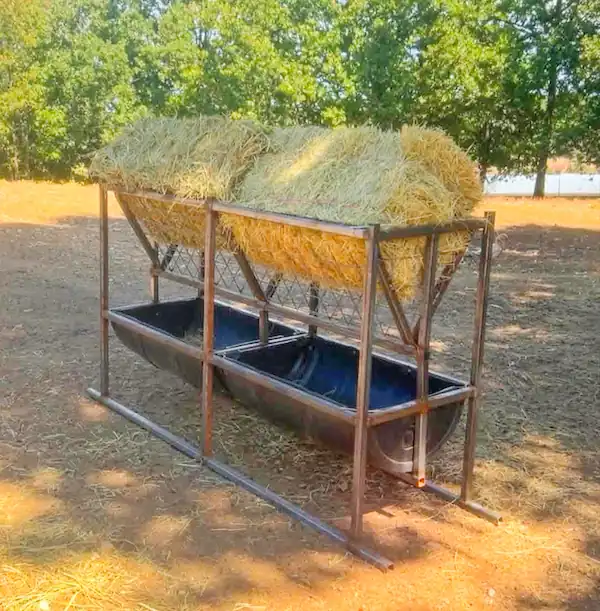
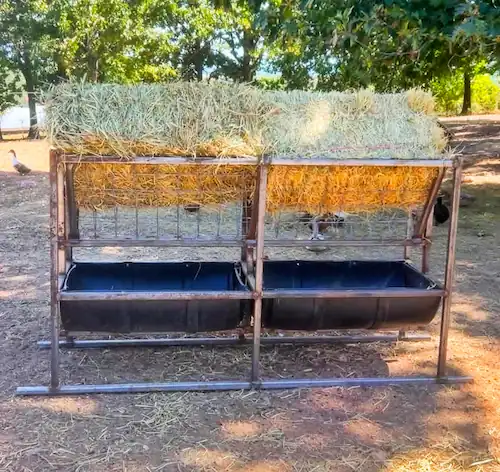
When we want one feeding station to handle both hay and grain, this TEXOTZAN feeder gives us a practical setup.
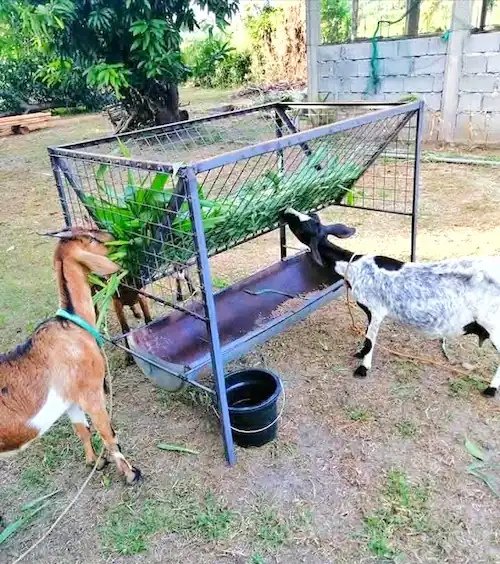
The upper section holds hay off the ground, while the lower 25-gallon trough catches loose stems and gives you a separate place for grain or pellets.
That separation is useful because we don’t have to mix the two feeds together or put a second pan beside the hay rack.
Its 43-inch length also gives several goats room to feed from either side. At 35.8 inches high, it works well for a mixed-size group, and the four adjustable feet help keep the frame steady when the ground is not perfectly level.
We also like the fact that the hay rack arrives with its bars assembled. Anyone who has wrestled with loose feeder bars and misaligned holes during assembly will appreciate that little detail.
The frame weighs 37 pounds and uses Q235 carbon structural steel with M6 fasteners. That extra weight is useful when you have goats that like to push, climb, or generally test everything in their pen.
If your goats are constantly climbing on equipment, adding safe toys for goats can give them another outlet.
The main reason we’d put this one high on the list is the combination of hay and grain feeding in one sturdy station.
If you’re tired of watching good hay disappear into the bedding, the lower catch tray gives the loose pieces somewhere to land instead of immediately becoming waste.
2. NZJWZS 5-Quart Hanging Goat Feeders
| Key feature | Details |
| Feeder type | Hanging feed/mineral trough |
| Capacity | 5 quarts each |
| Pack size | 10 feeders |
| Material | Thickened high-density plastic |
| Mounting | Fence or panel hanging |
| Included hardware | D-clips and zip ties |
| Design | Open trough |
| Cleaning | Smooth interior |
| Best for | Grain, feed portions, loose minerals |
For separate feeding stations, a 10-pack of these 5-quart hanging troughs gives you plenty of flexibility.
You can mount individual feeders along a fence or goat panel and give each group its own feeding spot.
That works especially well when you need to separate goat minerals, grain, or smaller portions rather than putting everything into one large trough.
Its thick plastic construction keeps the weight down, while the integrated hooks, D-clips, and zip ties give you several ways to secure each feeder.
The open design makes filling and rinsing simple, and the 5-quart capacity is enough for routine feed or loose minerals without taking up much room.
One thing to keep in mind is the mounting hardware. For goats that push hard against their feeders, the supplied hooks may not be enough for every setup.
A stronger attachment method can be worthwhile, especially when mounting the troughs to livestock fencing.
This set makes the most sense when you need multiple small feeding stations rather than one large communal feeder.
It can also be handy for a barn with several pens, since you can keep feed portions separate without buying a large trough for every space.
3. Tiflev 3 × 3.5-Quart Hanging Goat Feeders
| Key feature | Details |
| Feeder type | Small hanging goat feeder |
| Capacity | 3.5 quarts each |
| Pack size | 3 feeders |
| Material | Plastic |
| Mounting | Fence or stall panel |
| Best use | Grain, pellets or small feed portions |
| Cleaning | Smooth, easy-rinse surface |
| Drainage | Can be added with small bottom holes |
| Best for | Small pens and separate feeding spots |
We like this style when you want to get feed up off the ground without giving goats a huge trough to climb into.
Each Tiflev feeder holds 3.5 quarts, and the three-pack gives us several places to spread out feed between goats or pens. These compact feeders can also work well for pygmy goats, kids, or smaller pens where a large trough would be unnecessary.
The compact size is one of its useful features. You can attach these to a fence or stall panel at a comfortable feeding height, making them a practical option for Nigerian dwarf goats and other smaller goats.
We’d still mount it securely because goats are very good at turning an innocent-looking feeder into a climbing challenge.
You can also drill a few small drainage holes in the bottom if the feeders are exposed to rain. The plastic is easy to rinse, and the clips make moving or repositioning the feeders straightforward.
For us, the biggest advantage is the size. You get enough room for a useful feed portion without installing a deep, oversized trough.
If your goats tend to sleep in anything large enough to climb into, a smaller hanging feeder can save you that headache.
4. DallerSoode 3.5-Quart Hanging Goat Feeders
| Key feature | Details |
| Feeder type | Hanging grain/mineral feeder |
| Capacity | 3.5 quarts each |
| Pack size | 2 feeders |
| Material | High-density BPA-free plastic |
| Mounting | Fence, panel or wall |
| Included | Clips/carabiners and mounting hardware |
| Front design | Wave-shaped feeding barrier |
| Cleaning | Smooth interior |
| Best for | Grain, pellets and minerals |
These DallerSoode troughs are built around a simple idea: mount the feed at the fence and leave the floor clear.
Each feeder holds 3.5 quarts, and the two-pack works well when we need separate stations for grain and minerals or want to spread feed between goats.
The wavy front edge helps create a barrier around the feed, while the smooth plastic interior makes cleanup quick.
You can hang the troughs from wire panels using the included carabiners, or use stronger screws and a solid backing when mounting them permanently to a wall or heavier livestock structure.
The size is also practical for goats with horns because there is enough room around the opening for normal access.
Still, mounting height and surrounding hardware matter. We’d position the feeder so your goats can reach the feed comfortably without having to force their heads through a narrow space.
This is a good fit when you want separate, easy-to-reach feeding points without taking up floor space.
For a larger or stronger goat, we’d pay particular attention to how the feeder is attached rather than relying entirely on lightweight mounting hardware.
5. Bi fujian 5-Quart Hanging Goat Feeders
| Key feature | Details |
| Feeder type | Hanging grain/pellet feeder |
| Capacity | 5 quarts each |
| Pack size | 3 feeders |
| Material | PVC plastic |
| Size | 11.4 × 6 × 5.3 inches each |
| Mounting | Fence or wall |
| Included | 6 clips, 6 screws and 6 washers |
| Opening | Wide curved access |
| Best for | Grain, pellets and small feed portions |
If you need several individual feeding spots, this three-pack gives you a straightforward way to set them up.
Each trough measures 11.4 × 6 × 5.3 inches and holds 5 quarts, giving you more room than the smaller 3.5-quart styles.
Its PVC construction has smooth interior walls, so leftover grain or pellets are easy to remove when it is time to clean the feeder.
The curved opening also helps keep feed contained rather than letting goats push everything straight onto the ground.
Its mounting is flexible. The feeders come with clips, screws, and washers, and the side holes allow them to be attached to fencing or a more permanent structure.
For goats that like to shove their heads or shoulders against anything they can reach, I’d use a solid mounting point rather than relying on a lightweight fence section.
The extra capacity is the main difference here. These are a useful middle ground between a tiny individual feeder and a large communal trough, especially when you want separate portions for different goats.
6. ETSSXYSO 45-Inch Stainless Steel Goat Feed Trough
| Key feature | Details |
| Feeder type | Metal livestock feed trough |
| Length | 45 inches |
| Capacity | 24 gallons |
| Material | Stainless steel |
| Bottom | V-shaped |
| Handle | Yes |
| Use | Indoor or outdoor |
| Cleaning | Smooth surface |
| Best for | Multiple goats feeding together |
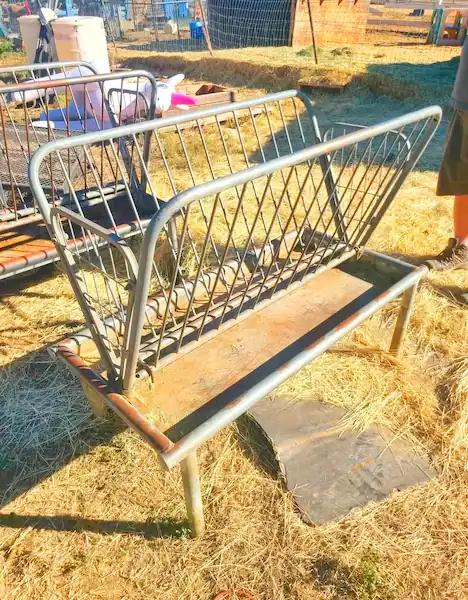
A long metal trough makes sense when several goats need to eat at the same time.
This ETSSXYSO model stretches 45 inches across and has a 24-gallon capacity, giving goats more room to spread out instead of competing for one small feeding pan.
The stainless-steel construction is the big selling point. It is designed to resist rust and corrosion, and the V-shaped bottom helps keep the trough stable while goats are eating.
There is also a handle for moving it around the barn or yard, which becomes useful when you need to clean the feeding area.
Putting this feeder together can take a little muscle. The sheet-metal pieces need to be lined up carefully before the bolts will go in properly, so having a second person to help hold everything in place makes the job much easier.
A few basic hand tools, and possibly a drill, can also save some frustration during assembly.
Once it is put together, the solid metal construction gives us a sturdy trough that stays in place instead of getting pushed around by the goats.
This is the type of feeder we’d look at when durability and group feeding matter more than having individual feeding cups.
Its long trough gives several goats access at once, while the metal construction is better suited to goats that climb, push, and generally put their feeders through a workout.
7. Mozoba 4-Quart Hanging Goat Feeders
| Key feature | Details |
| Feeder type | Hanging grain/mineral feeder |
| Capacity | 4 quarts each |
| Pack size | 3 feeders |
| Material | High-density polymer |
| Mounting | Fence or pen panel |
| Included | 2 clips and 2 screws per feeder |
| Design | Compact open trough |
| Best for | Grain, pellets and loose minerals |
| Best suited to | Small pens and individual feeding |
For a smaller feeding station, these mozoba troughs keep things simple. The three-pack includes 4-quart feeders that can be attached to wire fencing or a goat panel with the included clips and screws.
Keeping the feed elevated helps prevent it from sitting directly on the ground and makes it easier to maintain separate portions.
They are particularly useful for younger goats or smaller pens where a large trough would take up unnecessary space.
Each feeder is compact enough to discourage goats from climbing inside, while still giving one full-size goat room to eat comfortably.
With several goats sharing a pen, using multiple troughs can also reduce the pushing and crowding that happens around a single feed pan.
The plastic construction keeps these feeders light, and the relatively small size makes them easy to remove, wash, and relocate when you change your pen setup.
The three separate troughs are useful when we want to spread goats out instead of making them fight over one feed pan.
For a baby-goat pen or a smaller herd, the compact design can be easier to work with than a long communal feeder.
8. VEVOR 80-Gallon 2-in-1 Goat Hay & Grain Feeder
| Key feature | Details |
| Feeder type | 2-in-1 hay and grain feeder |
| Total capacity | 80 gallons |
| Hay capacity | 56 gallons |
| Grain capacity | 24 gallons |
| Length | 57.9 inches |
| Construction | Q235 carbon steel tubing + galvanized steel plates |
| Feeding access | Suitable for multiple goats |
| Hay waste control | Lower pan catches loose hay |
| Safety design | Rounded frame and tray edges |
| Best for | Larger goat groups, pastures and pens |
At Carter Farm, we use a feeder like this when we need one sturdy station to handle both hay and grain for a larger group of goats.
The upper rack holds up to 56 gallons of hay, while the 24-gallon lower pan gives us a separate place for grain. Loose stems and smaller pieces of hay can also fall into the lower section instead of ending up under our goats’ feet.
Its 57.9-inch length gives several goats plenty of room to feed at the same time. VEVOR rates the feeder for 10 to 12 goats, although the actual number we’d use depends on goat size and how much crowding our herd tolerates.
We also like its construction for outdoor use. It combines Q235 carbon steel tubing with galvanized steel plates, and the reinforced frame gives it the solid feel we want around active goats.
Rounded edges on the frame and feeding pan are another useful touch, particularly when goats are pushing their heads around looking for the last bit of feed.
Its assembly is fairly simple because of the overlapping frame design. The instructions walk you through the setup, although having our own basic tools nearby is a good idea rather than relying entirely on what comes in the box.
One point you should watch with smaller or young goats is the height of the lower grain pan. It may be easier for larger goats to reach than very young animals.
For a larger herd at Carter Farm, the biggest advantage is having one long feeding station for hay and grain instead of several separate feeders.
The deep lower pan also gives loose hay somewhere to land, which can help us get more use from every bale.
DIY Goat Hay Feeders: Homemade Options We Can Build at Home
A homemade hay feeder does not need to be complicated to work well. At Carter Farm, we have built a useful feeder from materials we already have around the farm, as long as it keeps hay off the ground and gives the goats controlled access to it.
The simplest designs can be made from pallets, scrap lumber, PVC pipe, an old barrel, or even a section of cattle panel.
The important part is not making it look fancy. We want the structure to stay upright, hold the hay securely, and have openings that let the goats pull hay out without getting their heads or horns stuck.
Pallet Goat Hay Feeder
A pallet is one of the easiest starting points for a homemade hay feeder. We can turn one into a wall-mounted rack by adding a bottom section and a few wooden slats across the front.
The slats keep the hay contained while allowing goats to pull out small amounts at a time.
At Carter Farm, this type of feeder makes sense when we have a solid barn wall, fence post, or other structure where we can anchor it firmly.
A small square bale can fit into a properly sized rack, and raising the bottom above the ground helps keep the hay away from mud, manure, and wet bedding.
Before using an old pallet, we inspect every board carefully. Remove protruding nails, loose pieces, and splinters, then sand the edges smooth.
Untreated wood will also deteriorate much faster when it stays exposed to rain, so a covered location or weather-resistant finish will extend its useful life.
Basic Setup
- Pallet or exterior lumber
- 2×4 framing pieces
- Wooden front slats
- Exterior-grade screws
- Sandpaper
- Wall or post anchors
Keep the openings large enough for adult goats to pull hay through but not so large that they can pull entire mouthfuls out at once. We recommend 3–4-inch openings for adult goats and smaller openings for kids.
PVC DIY Goat Hay Feeder
PVC pipe gives us another inexpensive option, especially when we want a compact feeder for a stall or smaller pen.
A section of large-diameter PVC can be mounted horizontally, with several openings drilled along the front. We fill the pipe with hay and let the goats pull it through the holes.
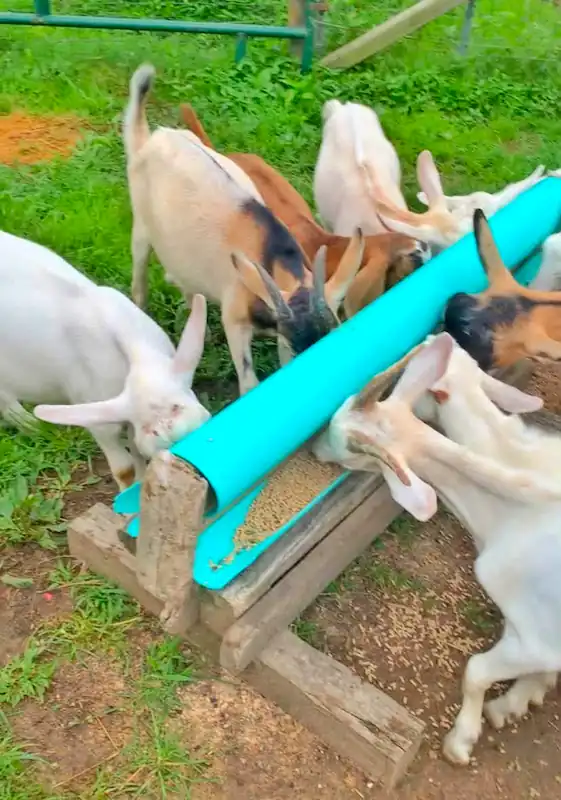
This design works more like a slow feeder than an open hay rack. The goats cannot grab a whole flake at once, so less hay gets dragged onto the floor. For a small group, a 4- or 6-inch pipe can be cut to a convenient length and secured to a sturdy post or wall.
The edges around every hole need careful attention. After drilling, we should sand and deburr the openings until there are no sharp spots that could scrape a nose or mouth.
DIY 55-Gallon Barrel Hay Feeder
An old plastic barrel can become a surprisingly useful homemade hay feeder.
We can cut several vertical openings into the sides, smooth every cut edge, and mount the barrel upright so the goats pull hay through the slots.
The staggered openings are what make this design useful. Instead of giving goats one wide opening where they can grab a large amount of hay, we create several smaller feeding points around the barrel.
A sturdy base keeps the feeder upright, while a covered location protects the plastic from excessive sun exposure.
This is one DIY project where we would not rush the cutting stage. Every opening needs to be filed and sanded thoroughly.
The barrel also needs to be securely anchored because a full load of hay can make a homemade feeder surprisingly top-heavy.
Cattle Panel Goat Hay Feeder
For a larger herd, we can build a much bigger hay feeder from a galvanized cattle panel. The panel can be formed into a U-shaped or circular structure and secured to sturdy posts.
Hay goes inside the ring while the goats pull it through the panel openings.
This approach suits a pasture or larger goat pen better than a small homemade rack. It gives several goats access at once and can hold a substantial amount of loose hay.
Goatzy describes cattle-panel ring feeders as a group-feeding option and recommends checking the spacing carefully, particularly when kids are present.
The panel also needs to be anchored properly. You should not simply bend a cattle panel into a circle and leave it sitting loose in the pasture.
Goats will push against it, climb on it, and test every weak point. Strong posts, proper fasteners, and stable ground support are essential.
Homemade Hay Feeder from a Stock Tank
An old galvanized stock tank can also be converted into a useful goat hay feeder.
We can add a slatted frame across the top so goats reach through the gaps to pull out hay without climbing directly into the tank.
This gives us a deeper and more enclosed design than a basic pallet feeder. It is particularly useful when we want something that can hold a larger amount of hay while keeping most of it contained.
For the slats, we need enough space for the goats to pull hay through comfortably without creating an opening where a head or horn can become trapped.
The wooden parts should also be sealed for outdoor use, while the tank itself needs regular inspection for rust and damaged edges.
Homemade Hanging Hay Feeder
A hay net is probably the simplest homemade option of all. We can fill a strong hay net or bag, hang it from a secure point, and let the goats pull small amounts through the mesh.
This takes very little construction work, but the safety side deserves more attention than a basic wooden rack.
We need to keep the net at a height that prevents goats from getting a leg caught, use secure hanging hardware, and inspect the rope and mesh regularly for chewing or damage.
Mesh size also changes how quickly the goats can eat. Tighter mesh slows access, while larger openings let them pull hay out more easily.
A Simple Rule for Any DIY Goat Hay Feeder
Whatever material we use, the same checks apply before putting hay inside. The feeder should be strong, stable, smooth, and easy for the goats to reach.
We want every cut edge sanded, every screw or nail secured, and every opening checked for possible horn or head entrapment.
The feeder should also be mounted firmly enough that goats cannot tip it over or pull it away from the wall.
For a homemade feeder, spending a little extra time on the mounting is much better than discovering later that the goats have turned our DIY project into a pile of lumber on the floor.
If we are building for both adults and kids, the opening size deserves extra attention. A gap that works for a full-size goat may be too large for a young kid.
Measuring the goats before cutting the final openings is an easy step that can prevent a lot of problems later.
DIY can save money, but it should not mean cutting corners on safety. A simple pallet rack or PVC feeder can work extremely well when it is built around the goats’ size and feeding habits.
When we need to feed a large herd or handle heavy loads of hay, a properly anchored cattle-panel, stock-tank, or heavy timber design gives us a much stronger homemade solution.
How to Choose the Right Goat Feeder
The right goat feeder depends on more than its size or price.
You need to match it to your herd, the type of feed, the goats’ size and horns, and where you plan to use it.
Herd Size and Feeding Space
For adult goats, 12–18 inches of feeder space per goat is a useful starting point. Larger goats and horned animals may need more room.
Several smaller feeders can also work better than one crowded trough, especially when dominant goats push others away.
| Goats | Approx. feeder space |
| 2 | 24–36 inches |
| 4 | 48–72 inches |
| 6 | 72–108 inches |
| 10 | 120–180 inches |
Horned vs. Polled Goats
We need to be more careful with feeder openings when our goats have horns. A gap that seems roomy can still allow a horn to enter but make it difficult for the goat to pull its head back out.
There is no universal 6-inch or 8-inch rule that is safe for every goat, so we should judge the spacing against the actual animals using the feeder.
Look for:
- Smooth edges with no sharp metal.
- Openings that let the goat withdraw its head easily.
- No gaps where horns can become trapped.
- Extra care when kids and horned goats share the same feeder.
Indoor vs. Outdoor Use
For a barn or shed, we can focus on easy cleaning, secure mounting, and keeping feed away from bedding and manure. The feeder also needs to fit the space available in the goat housing and pen.
Outdoor feeders need to handle rain, mud, wind, and sunlight. A covered hay feeder or one with a drainage system will protect feed better than an open feeder sitting on the ground.
Keeping the feeding area dry and clean also helps reduce contamination.
Metal vs. Plastic vs. Wood
| Material | Pros | Cons | Best for |
| Metal | Strong, durable | Heavy, may rust | Large herds, outdoor use |
| Plastic | Light, washable, rust-free | Can crack or deform | Grain, pellets, minerals |
| Wood | Cheap, customizable | Can rot or splinter | DIY hay feeders |
At Carter Farm, we lean toward metal for heavy-duty feeding, plastic for smaller hanging feeders, and wood when building a homemade hay feeder to fit a particular space.
Goat Feeder Budget
| Budget | What you can expect |
| DIY: Free–$30 | Pallet, scrap wood, PVC or repurposed materials |
| Mid-range: $30–$150 | Hanging feeders, smaller metal racks and combination feeders |
| Heavy-duty: $150+ | Large metal hay racks and commercial feeding stations |
A cheap feeder can work perfectly well if it is sturdy and safely designed. You should spend more when you need greater capacity, stronger construction, or a feeder that will stay outdoors year-round.
The main thing is making sure the feeder stays stable and gives every goat safe access to its feed.