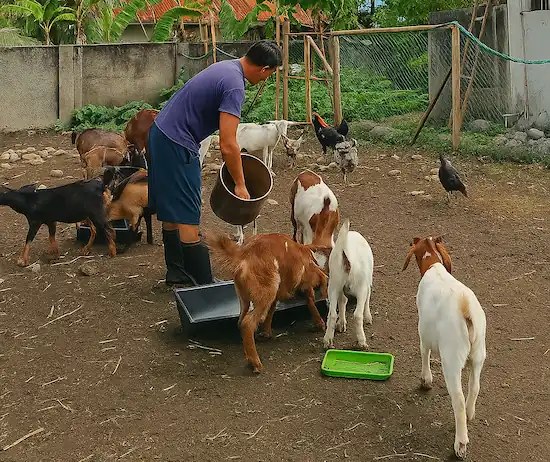
Goats are primarily browsers rather than grazers. They naturally seek out leaves, twigs, shrubs, weeds, and other plant material, and they may even wander into a garden or someone’s yard looking for something to eat.
But their curiosity around food can also get them into trouble. Goats may nibble on plants that are unsafe for them, and eating too much of a particular food can upset their digestive system.
We learned this the hard way with one of our family goats. She once ate a large amount of palm fruit, which upset her stomach.
She eventually stopped eating and sadly passed away. While we cannot say for certain that the palm fruit was the cause of her death, the experience showed us how important it is to know what goats can safely eat and what foods should be avoided.
A goat’s diet is more than just forage, treats, or whatever it happens to find. Knowing what to feed goats, how much to offer, and which foods and plants to keep away from them can help you build a safer, more balanced feeding routine.
The Basics of Goat Health and Diet
Goats stay healthy when their diet matches the way their bodies are built to digest food. Unlike animals with a simple stomach, goats have a four-part stomach: the rumen, reticulum, omasum, and abomasum.
The largest part, the rumen, is full of tiny microbes that ferment and break down food, making it easier for goats to absorb nutrients.
For this process to work well, fiber is key. A diet rich in fiber keeps the rumen balanced and prevents digestive issues.
Another important thing to understand is that goats are natural browsers, not grazers. Along with that, they are ruminants, which makes their diet unique.
It’s not just about what they like to eat, but also about how their digestive system is designed to handle it. It will protect you from the painful experience we went through when we lost our goat.
What to Feed Goats: The Core of Their Diet
Grain and Concentrates
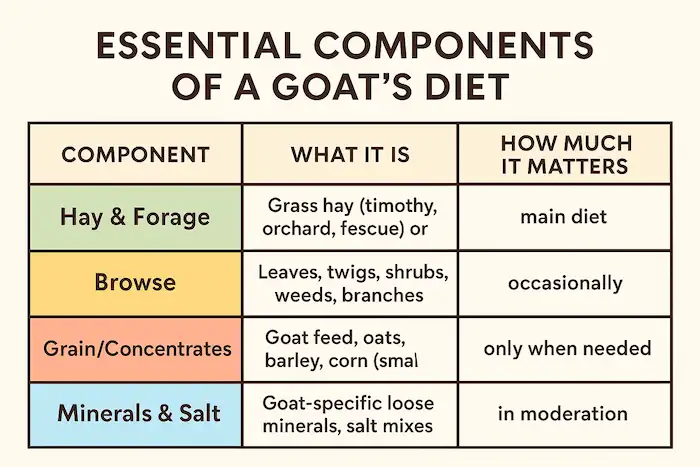
Grain isn’t the main part of a goat’s diet, but it can be a good supplement when they need extra energy, protein, or fat. This is usually during growth, lactation, pregnancy, cold weather, or when forage quality is poor.
The whole grains or grain mixes that work best for goats are oats, barley, and corn. My mother offers barley and oats mixed with molasses in winter when the goats are in lactation or pregnancy. She also adds apple cider vinegar to feed for coat health.
The women in our home usually have great experience with supplementary diets for goats. My grandmother has raised them for almost three decades, and she confidently knows what grains work for goats and what don’t.
It was surely her long experience that enabled him to learn everything about goat feeding. She always advised me never to feed grain free-choice and to make sure it matches each goat’s needs, weight, and production level. Overfeeding grains can lead to acidosis or bloat.
1. Wholesome Harvest Non-GMO All-Grain Goat Feed
If you prefer feeding whole or cracked grains rather than pellets, Wholesome Harvest Non-GMO All-Grain Goat Feed (Shop on Amazon) is an option worth considering.
It provides 16% crude protein and combines cracked corn, roasted soybeans, kelp, probiotics, and added vitamins and minerals.
The formula also includes vitamins A, D, and E, selenium, calcium, phosphorus, and ammonium chloride. I particularly like that it comes in a cracked-grain form with less fine powder, which can mean less feed dust and waste around the feeder.
The 40-pound bag makes more sense for regular feeding or a small herd than the smaller 10-pound option. As with any grain-based goat feed, use it as a supplement rather than replacing the forage that makes up the foundation of the diet.
Best for: Goat owners looking for a non-GMO, 16% protein grain-based feed for supplemental nutrition.
2. New Country Organics Goat Feed Pellets
For goat owners who prefer a pelleted ration, New Country Organics Goat Feed Pellets (Shop on Amazon) takes a different approach.
It is certified organic, non-GMO, and soy-free, with 15% protein and ingredients such as organic field peas, alfalfa meal, barley, oats, wheat, sunflower meal, flaxseed, and corn.
The formula is designed for all life stages and includes added vitamins, minerals, trace elements, and several fermentation products.
The manufacturer also provides different feeding guidelines for maintenance, gestation, and lactating goats, so the amount can be adjusted according to the animal’s needs.
I’d consider this one when ingredient sourcing is a priority and you want a pellet that can supplement pasture or hay without relying on soy.
Best for: Goat owners looking for an organic, non-GMO and soy-free pelleted feed.
3. Purina Goat Feed
Purina Goat Feed (Shop on Amazon) is a simple pelleted option for adult goats, particularly where you want a familiar commercial feed rather than a specialty organic formula. The product provides plant-based protein along with key trace minerals and vitamins A, D, and E.
Its formulation is intended to support general nutrition, milk production, fertility, immune function, and skin and coat condition. The 50-pound bag also makes it practical for owners who regularly supplement several goats.
For me, the main appeal here is simplicity. If your goats already have good-quality forage and you need a conventional pelleted feed to round out the ration, this is the type of product that can fill that role without adding unnecessary complexity.
Best for: Goat owners looking for a conventional pelleted feed for routine supplemental feeding.
Minerals & Salt
Goats need minerals that are different from those of other livestock. While sheep can’t handle much copper, goats need more of it. Therefore, it’s best to use mineral mixes made just for goats.
Loose minerals work better than blocks, since goats can eat them more easily. Essential minerals include copper, selenium, zinc, calcium, and phosphorus. Salt is also a must for hydration and overall health, and it is usually part of mineral mixes.
REDMOND Goat Mineral Supplement
For goats that need a loose mineral source, REDMOND Goat Mineral Supplement (Shop on Amazon) is a practical option to consider. It comes in a granulated form and provides a broad range of naturally occurring trace minerals, with the product listing 63 minerals.
I like the loose format because it fits well with the free-choice mineral approach discussed above. The 25-pound bag is also a useful size if you’re feeding several goats, while smaller options are available if you have a small herd or want to try it first.
This should complement a balanced forage and feed program rather than replace a complete goat mineral supplement. Make sure the mineral you choose matches the needs of your goats and the rest of their diet.
Vitamins
Goats need vitamins A, D, and E, plus water-soluble ones like B-complex and C. Luckily, rumen microbes produce most of the B vitamins, but sometimes vitamin shots are needed if a goat is stressed or deficient.
Manna Pro Goat Skin & Coat Supplement
If coat condition is one of your priorities, Manna Pro Goat Skin & Coat Supplement (Shop on Amazon) provides a more targeted nutritional option. Its main ingredients include ground flaxseed, rice bran, vegetable fat, zinc, vitamins A and E, and biotin.
The flaxseed supplies omega-3 fatty acids, while zinc, biotin, and the added vitamins are intended to support normal skin and coat condition. It can be particularly useful for owners who want an additional supplement for show goats or animals with a dull-looking coat.
I would treat this as an add-on, not a replacement for good forage, adequate protein, and a properly formulated mineral program.
Hay
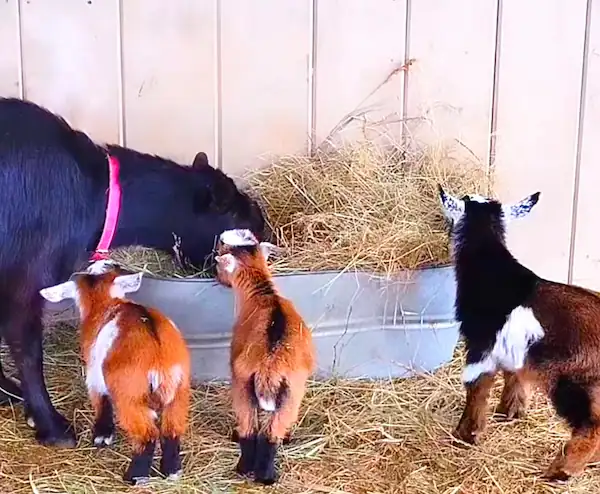
Hay is the backbone of a goat’s diet. It’s not only their essential diet, but several goat owners say their goats go crazy for hay.
All you have to provide is a good-quality hay. Good hay can be legume-based like alfalfa and clover, or grass types like timothy, orchard grass, and fescue. The best hay is green and leafy one that is free from mold, dust, or weeds.
If I talk about our personal goats, we usually offer them alfalfa in winter as it’s high in protein and calcium. While in summer, we usually go with the mixed grass hay. Don’t feed alfalfa hay to your male goats in huge amounts because of the risk of urinary calculi.
Other types of hay that goats enjoy are peanut hay, oat, and teff hay. These could be offered as replacements if the legume or grass hay is not available.
Some people let their goats eat hay all the time (free-choice), while others control the amount. Using hay feeders or nets is a good way to avoid wasting hay.
Pasture
A healthy pasture is just as important. Rotating grazing areas helps keep the land fresh, encourages natural browsing, and prevents overgrazing. But be warned about parasites and toxic plants, as they can be problematic for your goat.
Browse
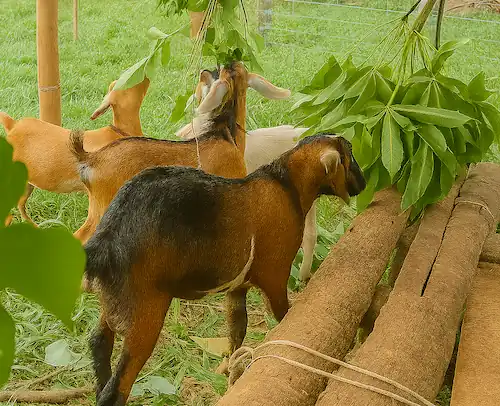
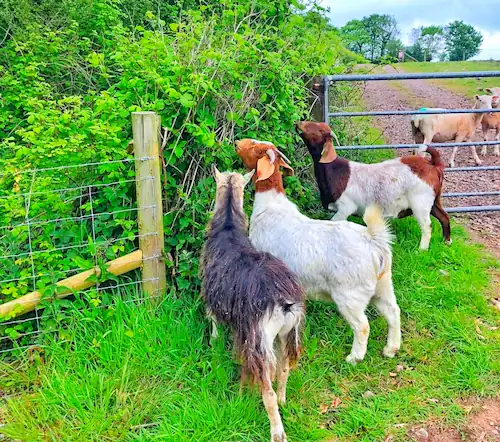
Goats are natural browsers, meaning they love munching on branches, shrubs, and leaves. This helps keep their teeth in good shape and gives them mental stimulation.
Safe options include fir, willow, maple, pine, sumac, brambles, oak leaves in moderation and other evergreens. If you don’t have natural browse available, you can offer them cut branches as well.
My father cuts branches of pine and fir for our family goats in the winter, and they always enjoy them. Since in cold weather fresh forage is limited, this can be the favorite of your goat.
Medicated Goat Feed for Parasite Control
If parasites are a confirmed problem in your herd, Manna Pro Positive Pellet Goat Dewormer (Shop on Amazon) is a medicated feed option rather than a regular daily goat ration.
It is formulated to help control several gastrointestinal worms, including barber pole worm, tapeworm, and brown stomach worm.
The pellet format may be useful for owners who have difficulty administering oral drenches or injections. The product is labeled for meat and dairy goats, including pregnant and lactating does, but it should be used according to the product label and your veterinarian’s advice.
I would not keep this feed available as a routine mineral or grain supplement. Dewormers should be used as part of a parasite-control plan, ideally based on the actual parasite risk and appropriate testing.
Best Grain-Based Goat Feed
For goat owners who prefer grain-based feed over pellets, Wholesome Harvest (Shop on Amazon) is an option worth considering. This feed contains 16% crude protein and is made with non-GMO grains, along with added vitamins, minerals, and other nutritional ingredients.
Its cracked-grain format is a nice middle ground if you don’t want a tightly compressed pellet. Its formula includes ingredients such as corn, roasted soybeans, kelp, and probiotics, with calcium and phosphorus added to support a balanced diet.
I would consider the 10-pound bag a practical choice for trying the feed first, while the 40-pound size makes more sense for regular feeding.
Features of Wholesome Harvest Goat Feed
16% crude protein
Non-GMO grain formula
Cracked-grain texture
Added vitamins and minerals
Includes probiotics
Available in 10- and 40-pound bags
What Goats Eat in the Wild
Goats in the wild or those kept in natural, free-range setups eat a wide variety of plants depending on what grows in their environment. Their diet is diverse and changes with the seasons.
Most of the time, they’ll go for grasses, weeds, shrubs, tree bark, and wildflowers. They love seed heads when grasses are ripe, and if there’s a patch of forbs, they’ll munch away happily.
When the seasons change, their menu changes too. In the fall, goats will clean up fallen nuts, pods, and seeds, even pecans with the shells on.
They’ll also go for muscadine vines, willow leaves, or whatever fruit or berry happens to drop nearby. Different goats have their favorites, too. What one goat loves, another might turn its nose up at.
Winter can be tougher. In the wild, when the ground is covered in snow, goats depend more on woody plants and dried forage they can still find. That’s why domestic goats usually need hay in the colder months, because nature doesn’t offer as much variety then.
Water: The Most Important Nutrient
Water is equally essential for goats as food, and it is often even more vital. It helps with digestion, nutrient absorption, and all the body’s basic processes.
Without enough water, goats can quickly get dehydrated, and this is specifically risky for lactating does (mothers producing milk). Water also helps flush out waste and keeps the whole system running smoothly.
The goat owners should ensure water availability 3-4 times a day, usually after feeding or before going to bed. Provide water in clean buckets and troughs to stop algae or bacteria from growing.
Always make fresh water available to them, especially in hot weather or if it gets dirty. In winter, make sure the water is not frozen or extremely cold. Slightly warm water can even discourage goats from drinking more.
Feeding Goats by Life Stage and Purpose
Goats don’t all eat the same way throughout their lives. Nor should you let them eat the same thing throughout the season.
What they need depends on their age, health, and the purpose for which they are using it. Whether they’re kids, milkers, breeders, meat goats, fiber goats, or just pets. Feeding them at the right stage is crucial to maintaining their health and productivity.
Baby Goats (Kids)
Like other mammals, the baby goats need the first milk, known as colostrum, right after birth to build immunity and strength.
If the mother goat is healthy and produces enough milk, keep it provided to their baby goats until they are 6 weeks old, and totally depend on hay and browse feeding.
When our goat hatched twin baby goats, the mother goat’s milk was not enough for both babies. So, we provided the kids with dam’s milk. You’ll have to ensure the same for your goats in case the goat babies depend on milk replacer.
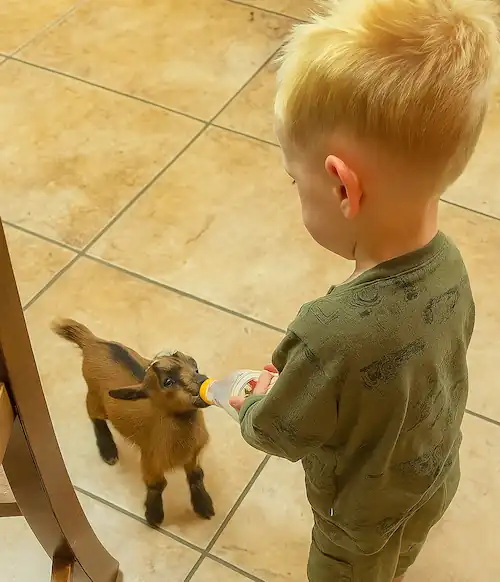
What you all have to do is feed them milk from a bottle with a nipple held up at their head level, so they drink the way they naturally would from their mom.
Don’t let them slurp milk from a bowl or bucket, and never mix it in with solid feed. If the milk ends up in their rumen instead of the stomach, it can ferment and make them sick.
As they grow, reduce the frequency and amount of milk gradually. And in the same while, start to offer grass hay, browse, and soft twigs/leaves. This helps the rumen develop properly.
You can offer small amounts of grass or hay pellets, but avoid alfalfa pellets unless feeding pregnant or lactating does, since alfalfa is too rich for young bucks.
Manna Pro Goat Kid Milk Replacer
When a kid cannot get enough milk from its dam, a properly formulated milk replacer can provide an alternative source of nutrition. Manna Pro Goat Kid Milk Replacer (Shop on Amazon) is designed for goat kids from the second day of life through weaning.
The powder provides 23% all-milk protein and 26% fat, along with vitamins, minerals, and Opti-Gut probiotics. It is mixed with warm water before feeding, so it can be used for bottle-fed kids when supplemental or replacement milk is needed.
I would keep this product specifically in the kid-feeding category. It is not a substitute for colostrum, and the feeding schedule should be based on the kid’s age, size, health, and whether it is receiving any milk from its mother.
Growing Goats
Young goats need a diet that supports steady, healthy growth. Ensure lots of energy and protein for strong bones and muscles, but not so much that they get fat too quickly. It could be forage as the main diet, grain mixes in moderation, and legume hay (alfalfa) as a protein source.
Pregnant Does
In early pregnancy, a normal maintenance diet is usually enough. But in the last 6–8 weeks, their nutritional needs increase to support the growing kids and prevent problems like pregnancy toxemia.
The last six weeks of goat pregnancy before kidding are very crucial. During that phase, don’t compromise on a quality diet like a mix of legume hay, i.e., alfalfa, a small amount of grains, protein supplements, minerals, and salt.
Lactating Does (Milking Goats)
Nursing moms have the highest nutritional demands. They need extra protein, energy, calcium, and phosphorus to keep up with milk production. Their diet must be carefully balanced during peak lactation and adjusted as milk production naturally declines.
To support milk production, ensure legume hay, soybean meal, or formulated dairy goat pellets along with the goat’s main diet. Milk is about 85–90% water, so it does need lots of clean water daily. A lactating doe can drink up to 2–3 gallons per day.
Bucks (Male Goats)
When not breeding, bucks can live on a simple maintenance diet. During breeding season, though, they need more nutrition for energy and sperm production. Be careful not to overfeed them, as this can cause urinary stones, known as a water belly.
Goats by Purpose
Meat Goats: Diet should support fast, efficient weight gain with enough protein for muscle. A legume hay, like alfalfa, is good to offer them with a mix of grains and concentrates.
Fiber Goats (Angora, Cashmere): Fiber goats are goat breeds that are raised mainly for their fiber (hair and wool) instead of milk or meat. Need extra protein and special nutrients like sulfur amino acids for fiber growth.
Fiber goats should be provided with high-quality grass hay, such as timothy and alfalfa in moderation. Black oil sunflower seed for lanolin production can also work.
Pet Goats: These guys are often at risk of overeating. Their diet should focus on forage and maintenance, not fattening. For non-breeding stock of pet goats, high-quality grass hay works well.
Feeding Goats by Their Breed
Mountain Goats
Mountain goats live in steep, rocky areas of North America, especially in the Rocky Mountains. They belong to a different genus (Oreamnos), but they are close relatives of domestic goats and sheep. They eat grasses, herbs, mosses, shrubs, and lichens.
In summer, mountain goats eat grasses and sedges when the alpine meadows are green. When grass is scarce, they eat shrubs and woody plants like willow or dwarf trees. In rocky areas at higher altitudes where other food is limited, they eat mosses, lichens and ferns.
Miniature Goats
Since miniature goats are small, they can be easily overfed, especially with alfalfa hay and grains. The small breeds of goats are particularly prone to urinary stones, so they require a balanced diet with a calcium-to-phosphorus ratio.
Hence, you’ll need extra caution regarding their diet. The two well-known breeds of miniature goats are:
1. Nigerian Dwarf Goats
Nigerian Dwarf goats are small and active animals that are often kept for milk. Therefore, their diet should be supplemented to meet these needs, enabling them to produce more milk and remain active.
Hay is their main diet. Orchard grass hay is a favorite, but alfalfa is great too, especially for young girls or moms making milk.
Our Nigerian dwarf goats have 24/7 access to orchard grass hay, even if they’re grazing or browsing. In summer, they sometimes ignore it, but once winter hits, they go crazy for it.
If there are baby goats and does in milk, make available some grain or goat feed for them, around ¾ cup per goat daily. Always keep a dish of loose goat minerals where they can reach them.
2. Pygmy Goats
The diet of pygmy goats is not that much different from that of other goats. They have a little more browser nature and will feed on twigs, shrubs, weeds, and higher forage.
They enjoy eating fruits and vegetables, such as carrots, apples, peanuts, and sunflower seeds, but these should be considered occasional treats.
Most goat owners prefer to feed sweets and candy items, but they’re not healthy and should be avoided. To the female pygmy goats, you can offer grains, but not to the bucks, the male goats.
Boer Goats
Boer goats are a meat goat breed that originally came from South Africa. They were developed by crossing local goats with imported European breeds, mainly for their fast growth and high-quality meat.
Boer goats are usually fed a lot like dairy goats. For example, adult females do well on dairy pellets that have around 18% protein, along with alfalfa pellets and some grass or weed hay. The males, on the other hand, usually thrive on meat grower pellets, with a bit of alfalfa hay.
Many experienced goat keepers also work with local mills to create custom grain mixes, usually around 16% protein and always pair them with good-quality grass hay. This balance of protein, fiber, and forage supports their health and growth at every stage.
Fainting Goats
Fainting goats mainly need hay, grass, weeds, leaves, minerals, and plenty of fresh water. Most people recommend offering them corn and grain. But they don’t necessarily need grain or corn, and those can even cause problems if given too much.
If you do use them, keep it to tiny amounts and only when it’s actually needed, like for a mama goat with babies or during cold winter weather.
Goat Treats
Goat treats can be useful as an occasional reward, training aid, or way to make handling easier. They should complement a goat’s normal diet rather than replace hay, forage, or a properly formulated feed. Choose treats in moderation and avoid products that contain ingredients unsuitable for goats.
These apple-flavored nuggets are designed as an occasional treat for goats and sheep rather than as a replacement for their regular feed. The formula includes added vitamins, minerals, and probiotics, and it is made without added copper.
The small nugget size makes these easy to portion during training, handling, or simply as an occasional reward. The six-bag pack contains 30 pounds total, so it is more suitable for owners with several goats or those who use treats regularly.
Features
Apple-flavored nugget treats
Suitable for goats and sheep
Added vitamins, minerals, and probiotics
No added copper
Six 5-pound bags
30 pounds total
Safe Vegetables and Fruits (as treats)
Fruits and veggies are great as snacks or extras for goats, but they shouldn’t replace their regular food. If you try to feed them only fruits and veggies without the right balance, it can make them sick. The treats that your goat likes to eat are listed below.
Avoid sudden diet changes. Switching food too quickly upsets a goat’s rumen, their digestive system. Always add new feed slowly over 7–10 days.
The most widely made mistake is to offer too many grains. These can cause acidosis (tummy upset), bloat in goats, and even make them overweight. Measure grain carefully and feed based on each goat’s age, size, and activity, not just one big scoop for the whole herd.
Some owners have no idea of feeding minerals to their goats. They perhaps consider that hay and grass are everything goats need. This often leads to deficiencies, such as copper problems. Keep goat-specific loose minerals out at all times so they can lick as needed.
Cleanliness is the key to healthy eating. Moldy hay, damp bags, or pests getting into feed can create problems for flocks. Store feed in a dry, clean, and pest-proof place.
Foods Goats Should Never Eat
Since goats are curious eaters, they often nibble on anything they find, even clothes, labels, plastic, or cardboard at times. The only thing they don’t eat and should not be offered to are animals and animal-based products.
Many goat owners, especially beginners, may be misled by this behavior and assume that whatever goats eat must be safe for them. But that’s not true. Not everything is safe, and some foods are only safe in very small amounts. Below is a list of food items that need caution when offering to your goats.
Animal by-products like meat or bone meal. Goats are herbivores, not meat eaters.
Dog or cat food: wrong nutrients, and may contain animal by-products.
Avocado contains persin, which is toxic.
Onions can upset their stomach and cause diarrhea.
Citrus fruits (oranges, lemons, etc.) can cause digestive problems.
Cherry, peach, and plum leaves contain cyanide that is toxic for goats.
Moldy hay or feed can cause serious illness or even death.
Too many kitchen scraps: especially processed, salty, or sugary foods.
Alfalfa: Rich and tasty, but too much can cause urinary calculi, especially in males.
Mango Leaves: Studies show they are safe for goats in moderation. They contain Mangiferin, which is only harmful in very high quantities.
Plants Goats Should Not Eat
Goats are weird eaters and will sometimes try even deadly plants like rhododendrons or wilted cherry leaves.
It’s your job to keep those plants out of reach, because unlike their wild ancestors, domestic goats can’t always tell what’s safe. Some hazardous plants that goats should not eat are:
Rhododendrons, azaleas, and mountain laurel are highly poisonous, even in tiny amounts
Yew trees
Delphiniums
Pieris (Japanese Andromeda)
Wilted cherry leaves
Hydrangeas
Lantana
Buckeye & elderberry
Madre de Cacao: No strong evidence suggests it is harmful for goats, though caution is advised since research is limited.
Safety Tips for Feeding Goats
There has been much more discussion about what to feed goats. Now, it’s time to ensure safety tips while feeding goats. Always offer a varied diet, a rotation of hay, browse, and safe fruits and veggies. Avoid letting goats starve. Hungry goats may eat toxic plants if they are freely grazed.
On a fun point, goats are naughty animals and can climb trees, go to other gardens, and damage flowers. They also chew on non-food items, so keep them away from harmful things like fertilizers, pesticides, and weed killers. Also, provide fencing to control where goats browse.
Most importantly, goats can compete when they are fed all together. I usually keep them apart at feeding time, since that’s when the dominant goats usually take over and push the others away, especially if they’re new to the herd.
David Carter, founder of Farmstead Guide, has over 20 years of hands-on homesteading experience. From raising poultry to practicing sustainable farming, he shares practical tips and insights to help others live a more self-sufficient lifestyle.