Toys for Chickens
Chicken toys give a flock something to peck, scratch, climb, and investigate when the run gets boring. They are one small part of raising chickens well, alongside proper housing, nutrition, space, and daily flock care.
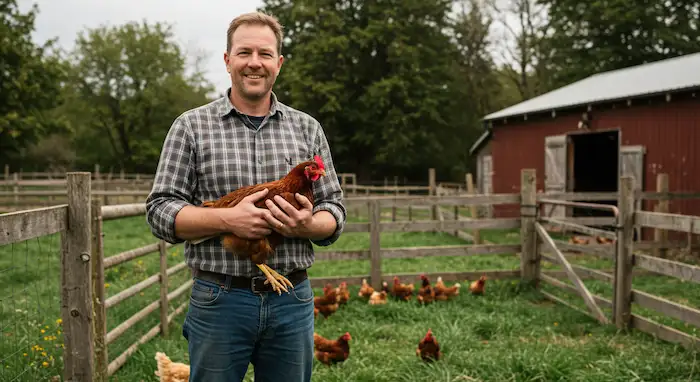
At Carter Farm, we’ve seen how quickly chickens can turn on each other when they have little to do. Feathers end up scattered around the run, one hen gets picked on, and a quiet flock can suddenly become a tense one.
Winter is especially tough. With fewer bugs, greens, and other things to forage, chickens spend more time looking for something to do. That’s where good enrichment helps.
We use a mix of store-bought chicken toys and simple DIY boredom busters at our farm to keep the flock busy without filling the run with unnecessary junk.
You’ll find our top chicken toys for the coop and run, along with cheap DIY boredom busters, enrichment ideas for chicks and hens, and winter options for keeping a flock busy.
We’ve also explained what each type of toy encourages, from scratching and foraging to pecking and climbing, plus the safety checks we use before adding anything to our run at Carter Farm.
Our Top Chicken Toys for the Coop and Run
Not every chicken toy needs to do the same job. Some give chickens something to peck, others encourage movement, and treat holders turn feeding time into a small foraging activity.
We look for toys that give the flock something useful to do without filling the run with clutter.
1. WUJCXRV 7-Piece Chicken Toy Set
Best for: A variety of enrichment in one package
This 7-piece set covers several chicken behaviors without requiring you to buy each item separately. It includes two swings, a ladder perch, xylophone, pecking toy, mirror with bells, and two hanging vegetable feeders.
| Feature | Details |
| Set size | 7 pieces |
| Main activities | Pecking, climbing, perching, foraging |
| Materials | Wood and metal |
| Vegetable holders | Fork and mesh bag |
| Installation | Hooks and chains |
| Best for | Runs and outdoor coops |
Fresh foods such as cabbage, lettuce, carrots, corn, and apples can go into its hanging holders, keeping them off the ground and turning treat time into a small foraging activity.
Along with that, the xylophone and bell mirror give chickens new sounds and sights to explore, while the swing and ladder encourage climbing and movement.
We like having several different activities in one set because not every hen will care about the same toy.
The swings, mirror, vegetable holders, and xylophone give chickens different ways to peck, forage, climb, and investigate. Check the dimensions before installing the pieces in a large-flock run.
2. WinnerWhy Multicolor Chicken Wind Chime
Best for: Pecking and sound-based enrichment
This hanging aluminum wind chime takes a much simpler approach. Chickens can peck at the colorful tubes, causing them to move and make noise. The 10.2-by-3.5-inch design also takes up very little space in the run.
| Feature | Details |
| Material | Aluminum |
| Size | 10.2 × 3.5 inches |
| Main activities | Pecking, movement, visual stimulation |
| Installation | Hanging hook |
| Weight | About 0.158 kg |
| Best for | Smaller enrichment areas |
The moving pieces and gentle sounds give curious chickens something new to investigate, but not every flock will take to it.
It works best as a small addition to a larger mix of enrichment rather than the only activity in the run.
Hang it within easy reach while keeping strings and hardware away from areas where birds could become tangled, and check the toy regularly for signs of wear.
3. 40 cm Natural Wooden Chicken Swing Perch
Best for: Perching and movement
A swing gives chickens a different way to use vertical space. This model combines a wooden perch with movable beads and a hanging metal decoration that gives birds something to investigate and peck.
| Feature | Details |
| Length | About 16 inches |
| Material | Wood |
| Main activities | Perching, jumping, pecking |
| Extra features | 5 wooden beads and hanging decoration |
| Installation | Included hardware |
| Suggested load | Up to 15 kg according to the listing |
| Best for | Smaller groups |
Its natural wood surface gives chickens a place to grip while the movable beads add another reason to investigate the perch. It can also help make a plain coop more interesting without taking up much floor space.
One limitation is that this swing may not suit every flock. It is better suited to lighter use, with limited space for birds on the perch at one time. Treat it as an extra enrichment option alongside other perches and activities rather than the main source of entertainment.
4. CHNB 8-Piece Chicken Toy Set
Best for: Combining foraging, pecking, and perching
The CHNB set takes the same broad approach as Product 1 but adds eight pieces: a swing, xylophone, mirror with bells, pecking toy, two vegetable feeders, and two fruit racks.
| Feature | Details |
| Set size | 8 pieces |
| Material | Chinese fir, metal, nylon |
| Main activities | Foraging, pecking, climbing, perching |
| Vegetable/fruit holders | 4 pieces |
| Installation | Chains and hooks |
| Best for | Coops and runs |
The hanging fruit and vegetable pieces are the strongest part of this set for practical enrichment. A cabbage or leafy vegetable takes longer to eat when chickens have to peck and pull at it.
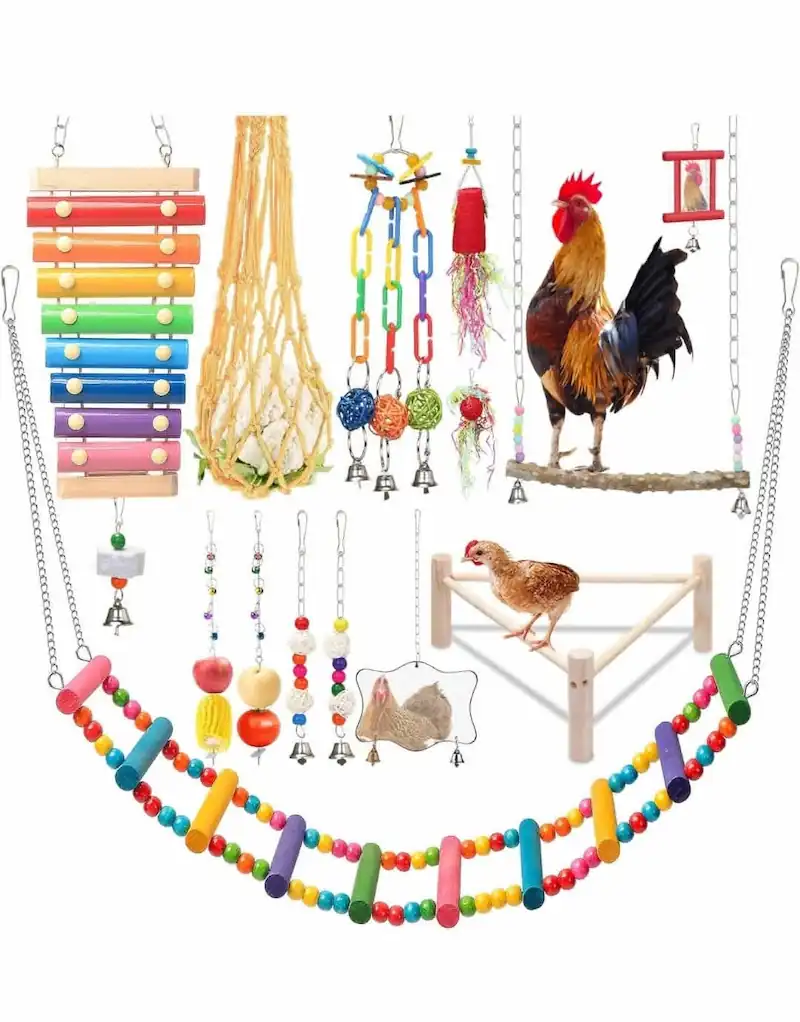
Its xylophone, mirror, and swing add different activities for birds that are more interested in movement and objects.
This set offers several types of enrichment, but individual chickens may use the pieces differently. The swing and food holders can add movement and foraging opportunities, while the other pieces provide pecking and visual activities.
It works best as a varied enrichment set rather than expecting every piece to appeal to the whole flock.
5. Suplklz Chicken Vegetable Hanging Feeder Toy
Best for: Foraging with fresh vegetables
This is one of the simplest ways to turn vegetables into enrichment. Its stainless-steel skewer holds foods such as cabbage, lettuce, corn, apples, and tomatoes above the ground, so chickens have to peck and pull at them.
| Feature | Details |
| Material | 304 stainless steel |
| Pack | 2 pieces |
| Skewer length | 9.2 inches |
| Adjustable chain | Up to 24 inches |
| Weight capacity | Up to 10 lb according to the listing |
| Main activity | Foraging and pecking |
We use hanging vegetables because they keep the flock working for a treat instead of eating it in a few bites from the ground.
Lettuce, cabbage, and corn work particularly well when we want the birds occupied for longer.
Safety matters with any hanging feeder. We keep the hardware securely fastened, close any gaps around the hook, and position the skewer where birds cannot become trapped or hang from it.
We also check the chicken feeders each time we use it for loose parts, sharp edges, or other hazards.
6. Hipykat 11-Piece Chicken Toy Set
Best for: A large mix of pecking, climbing, and foraging activities
We use a mix of enrichment rather than relying on one toy to keep the flock busy, and this 11-piece set follows that same idea.
It combines two wooden swings, a ladder bridge, mirror, xylophone, vegetable skewer, fruit bag, and four smaller pecking toys.
| Feature | Details |
| Set size | 11 pieces |
| Main activities | Pecking, climbing, swinging, foraging, exploring |
| Food enrichment | Stainless steel vegetable skewer and fruit bag |
| Materials | Natural wood, metal, stainless steel |
| Installation | Hanging hooks |
| Best suited to | Coops and runs needing several enrichment options |
| Current price | $29.21 |
Foraging is another strong point of this set. Fresh vegetables and fruit can be suspended in the included holders, keeping treats off the ground while encouraging hens to peck and work for their food.
The xylophone adds another beak-focused activity, while the swings and ladder bring climbing and movement into the setup.
Size is the main thing to check before installation. Several pieces are fairly compact, so match each toy to the size and strength of your chickens instead of hanging every item in the run at once.
Small parts, loose hardware, or damaged wood should not stay where chickens can peck or swallow them.
7. 2-Pack Large Chicken Calcium Chewing Toys
Best for: Beak activity and pecking enrichment
Instead of adding another swing or hanging feeder, this pair focuses on one simple behavior: pecking and chewing.
Each 13.77-inch toy combines porous mineral stones with colorful beads and a bell, giving chickens several textures and sounds to investigate.
| Feature | Details |
| Quantity | 2 hanging toys |
| Length | 13.77 inches each |
| Main activity | Pecking and chewing |
| Material | Calcium-rich mineral stone, beads, cotton rope |
| Added feature | Bell |
| Installation | Hanging rope |
| Best suited to | Chickens that enjoy pecking at suspended objects |
As chickens peck and chew, the textured mineral stones give their beaks a firm surface to work against.
Because the toy hangs freely, it moves with each interaction, creating a more active experience than a fixed calcium block.
One point to keep in mind is that mineral toys should not replace a properly formulated poultry diet.
We inspect the stones, beads, rope, and bell regularly. If any part becomes loose, cracked, sharp, or damaged, we remove the toy.
8. 10-Piece Chicken Toy Set
Best for: Smaller birds and compact enrichment setups
This set packs ten pieces into a relatively small package. You get a ladder, xylophone, mirror, two food holders, two swings, and three smaller hanging toys.
The combination gives chickens several things to investigate while taking up little space in the coop.
| Feature | Details |
| Set size | 10 pieces |
| Includes | Ladder, xylophone, mirror, 2 swings, 3 pendants, 2 feeders |
| Main activities | Pecking, climbing, swinging, foraging |
| Food holders | Nylon mesh bag and stainless steel fork |
| Materials | Nylon, stainless steel, wood, metal |
| Mounting | Ceiling or hanging installation |
| Best suited to | Small and medium breeds |
Its vegetable holders are particularly practical for hanging broccoli, cabbage, carrots, corn, tomatoes, or apples.
The xylophone and smaller pendants add additional pecking targets, while the ladder creates another place to climb and explore.
Its compact design also creates a limitation. Some components may be too small or lightweight for larger birds, and the short hanging hardware can limit where you can position them.
Any swing, ladder, or hanging toy should be checked for secure attachment before birds have access to it.
9. Sadnyy Extra-Large Double-Sided Chicken Mirror
Best for: Visual enrichment with a larger mirror
The Sadnyy double-sided mirror is one of our favorite chicken toys for visual enrichment.
We like the larger 10.6 × 9.8-inch size because it gives the flock a clear surface to investigate instead of the small mirrors found in many toy sets. It has reflective surfaces on both sides, with a bell underneath for an added pecking and sound activity.
| Feature | Details |
| Mirror size | 10.63 × 9.84 inches |
| Design | Double-sided |
| Materials | Acrylic and wood |
| Added feature | Bell |
| Mounting | Hanging hooks |
| Suitable for | Small, medium, and large breeds |
| Use | Indoor or outdoor enrichment |
Its generous surface gives chickens plenty to look at and investigate, while the bell underneath adds another reason to peck and interact with it.
A solid wooden frame surrounds the mirror, making it feel more substantial than the small mirror pieces found in many multi-toy sets.
There is one important consideration with mirrors: they do not suit every bird. A chicken may simply investigate the reflection and move on, while a rooster or dominant hen may repeatedly display toward it.
We watch the flock after installation and remove the mirror if it causes persistent agitation or aggressive behavior.
Its hanging hardware also deserves a check before use. Make sure the attachment is secure and that the mirror cannot swing into fencing or other objects where a bird could become trapped.
DIY Chicken Toys and Free Boredom Busters
You don’t need to spend money on every enrichment activity. Some of the best chicken boredom busters use things you already have around the house, garden, or farm.
Hanging Cabbage and Vegetables
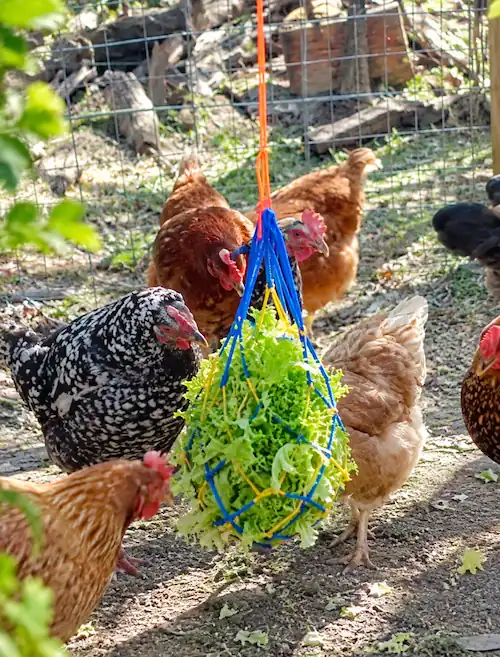
A whole cabbage or head of lettuce makes a simple DIY chicken toy. Tie it securely with sturdy twine and hang it around chicken head height.
As it swings, chickens have to peck and pull at it instead of eating it all at once.
We’ve watched our flock work through a hanging cabbage over several hours. The curious birds usually investigate it first, while others join once pieces start breaking loose. Interest can last much longer than a treat scattered on the ground.
You can also use corn on the cob, broccoli, or apple halves. Move the hanging spot each time you offer one to give the flock something new to investigate.
Replace the vegetable once it becomes heavily soiled or starts spoiling. Keep the hanging point secure and check the twine regularly.
DIY Treat Bottle
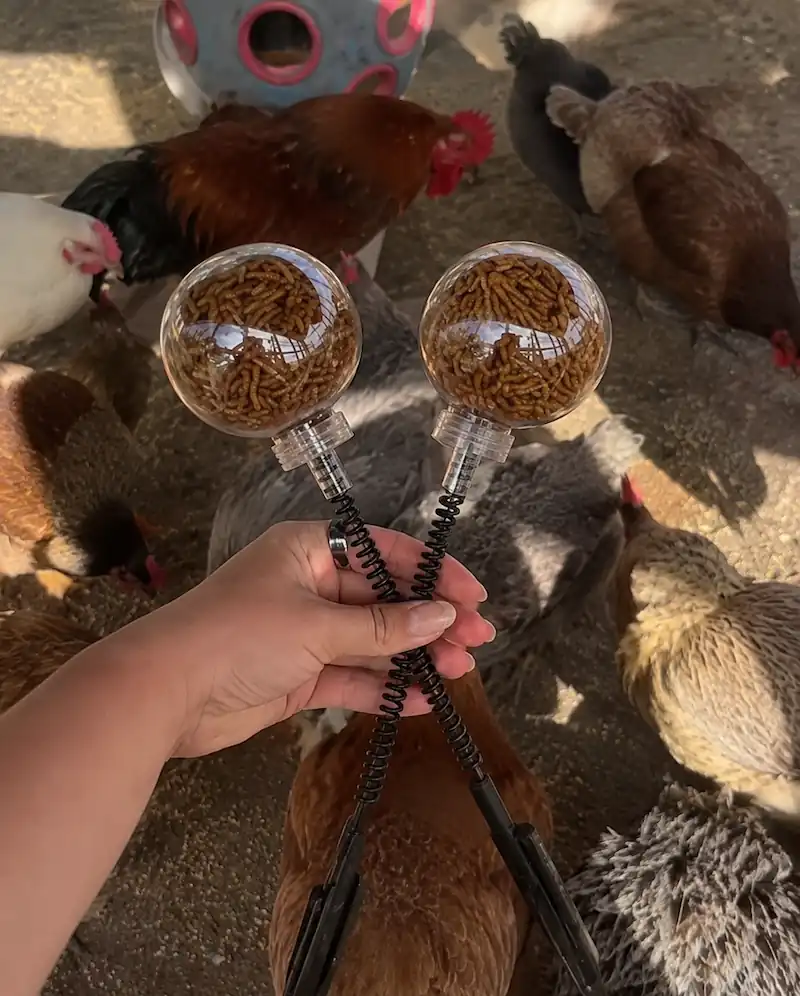
A clean plastic bottle can become a simple rolling treat dispenser. Make several small holes large enough for scratch grains or mealworms to fall through, add the treats, and place the bottle on the ground in the run.
Your chickens will peck and push the bottle around to release the food. Start with larger holes so they learn how it works.
Once they figure it out, smaller openings can make the activity last longer.
Smooth every hole after cutting or punching the plastic. Remove the bottle immediately if it develops cracks, sharp edges, or loose pieces.
Other Free Chicken Boredom Busters
Simple changes around the run can create useful enrichment without buying another toy:
- Scattered scratch grains: Encourages scratching and natural foraging.
- Leaf or straw pile: Gives chickens something to scratch through and investigate.
- Shallow sand area: Supports normal dust-bathing behavior.
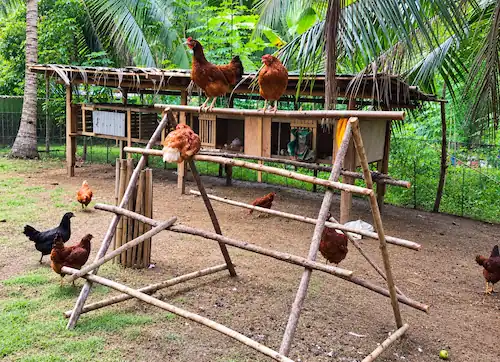
- Sturdy branches or dowels: Add extra perching and climbing opportunities.
- Half a pumpkin or squash: Gives chickens something to peck and work through.
- Fresh herb bundle: Adds a new smell and pecking target.
- Cardboard box with straw and treats: Encourages scratching and searching.
Rotate these activities instead of leaving everything available all the time. Moving a branch, changing the location of scattered treats, or replacing an old object with something new can renew interest without adding much cost.
Why Chicken Enrichment Matters
Chickens naturally spend much of their day scratching, pecking, foraging, exploring, and interacting with their flock.
When a run offers little to do, that energy has nowhere to go. Feather pecking, chasing, bullying, and fighting can follow.
We’ve notices this at our own farm. A flock with enough food and water can still become restless when the run gets boring. That doesn’t automatically mean you have aggressive or “mean” birds. Sometimes they simply need more ways to use the behaviors they’re wired to perform.
That is where chicken toys and enrichment earn their place. The IAABC Foundation Journal recommends choosing enrichment around natural behaviors such as foraging and pecking, while the
Open Sanctuary Project recommends varied enrichment that gives chickens opportunities to explore, forage, perch, scratch, and stay mentally engaged.
How Enrichment Supports Flock Welfare
A good chicken toy gives birds something to do, not just something to look at. Treat balls encourage pecking and foraging. Swings, ladders, and perches add movement and exploration. Rotating different options also keeps the run from becoming predictable.
At Carter Farm, we look for enrichment that helps with:
- Less idle pecking and feather picking
- More natural foraging and scratching
- Fewer opportunities for flock members to focus on each other
- More movement and exploration
- A more active, engaged flock
Enrichment is not a replacement for proper nutrition, space, ventilation, or health care. It gives chickens more useful ways to spend their time.
Signs Your Chickens May Need More Enrichment
Watch your flock for about 10 minutes at different times of the day. Look for:
- Repeated feather pecking or pulling
- One hen constantly chasing another
- Bullying around feeders or waterers
- Pacing along the run fence
- Restless squawking or agitation
- Excessive preening
- Long periods of inactivity when the flock would normally be active
These signs do not always mean boredom. Parasites, illness, poor nutrition, and overcrowding can cause similar behavior, so rule those out first. Make sure your flock also has enough room to move, forage, perch, and get away from other birds.
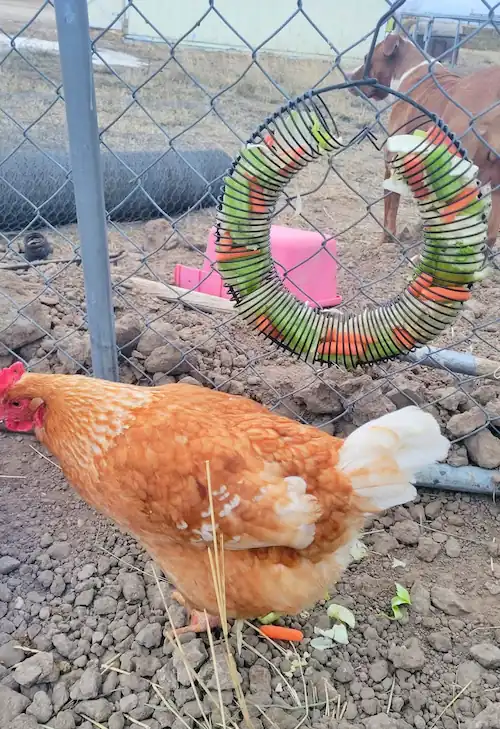
If boredom is part of the problem, the next step is to give your chickens something worthwhile to peck, scratch, forage, climb, or investigate.
The Natural Behaviors to Encourage
The best chicken toys give birds a reason to do what chickens already want to do. We choose enrichment based on the behavior it supports rather than buying something simply because it is marketed as a chicken toy.
Foraging
Foraging keeps chickens busy for a reason. They naturally scratch through the ground, peck at interesting spots, search for food, and investigate anything new in their space.
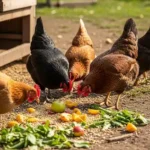
Treat balls, scattered scratch grains, hanging cabbage, and treat-filled bottles turn that instinct into an activity. These are the types of boredom busters we use when we want chickens working for their treats instead of eating them from a feeder.
Pecking
Pecking is not just about finding food. Chickens use their beaks to investigate objects, interact with their surroundings, and sort out flock relationships.
Give that beak a better target. Bells, xylophones, pecking blocks, and hanging vegetables can take some attention away from feathers and other birds.
Perching
A perch gives a chicken more than somewhere to sit. Birds use elevated spots to rest, sleep, watch the run, and get away from another chicken when the pecking order gets tense.
We prefer having several perches at different heights rather than one crowded perch. It gives lower-ranking hens somewhere to retreat and adds useful movement to the day.
Dust Bathing
A good dust bath is enrichment too. Chickens dig, roll, shake, and work loose material through their feathers as part of normal feather care and parasite control.
Keep a dedicated area filled with dry, loose soil or sand where your flock can bathe without getting soaked. We would not add diatomaceous earth routinely just for enrichment. A clean, dry dust-bathing area is the important part.
Visual Stimulation
Chickens notice movement and changes in their surroundings. A new object can be enough to get a flock investigating instead of standing around with nothing to do.
Mirrors, pinwheels, and other visual objects can add another type of enrichment. The Open Sanctuary Project has also discussed visual enrichment such as mirrors, CDs, and pinwheels for reducing fear in unfamiliar settings. Open Sanctuary Project
Use mirrors carefully around roosters, especially birds that are already confrontational. A reflection can trigger repeated displays or aggression rather than useful enrichment.
Flock Size and Rooster Considerations
Buying more chicken toys does not automatically mean better enrichment. The size of your flock, the birds’ personalities, and the presence of a rooster all affect which toys make sense.
How Many Toys Does a Flock Need?
A single toy can work for a couple of chickens, but it becomes easy for one bird to monopolize it as the flock grows. IAABC Foundation Journal recommends offering multiple enrichment options so lower-ranking hens have opportunities to participate without competing for one resource.
A practical starting point is one enrichment item for every four to five chickens, with the toys spread around the run.
Watch how your flock uses them and add another station if some birds are consistently pushed away.
For example, instead of hanging one vegetable toy in the busiest part of the run, place two or three enrichment stations in separate areas. This gives quieter hens another place to forage or investigate.
Watch for Toy Guarding
Some chickens will claim a favorite enrichment item just like they guard food or a preferred perch.
You may notice one bird standing over the toy, chasing others away, or repeatedly returning whenever another hen approaches.
We watch for this when introducing something new. If one chicken controls the entire activity, add another enrichment station farther away rather than simply moving the original one.
Multiple options give lower-ranking birds a better chance to participate.
Be Careful with Mirrors and Roosters
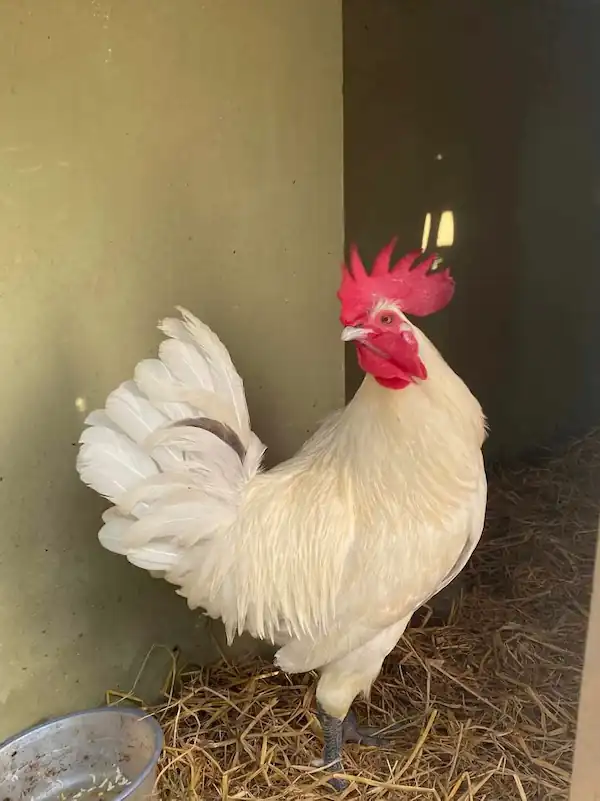
Mirrors need more observation when you keep a rooster. Some birds may ignore their reflection, while others can become confrontational toward it.
Open Sanctuary Project specifically recommends watching individual chickens around mirrors and avoiding them when a bird becomes threatened or aggressive toward its reflection.
If your rooster starts repeatedly displaying, pecking, charging, or guarding the mirror, take it out. For these flocks, foraging and food-based enrichment may be a simpler choice.
Match Toys to Your Birds
Your flock does not need the same enrichment as every other flock. Active, curious birds may spend more time climbing, investigating, and working for treats.
Older, heavier, or less mobile chickens may do better with enrichment that does not require jumping or balancing.
Start with a few different activities and watch which birds use them. If a toy consistently gets ignored, replace it with something that matches the behaviors your flock actually enjoys.
Seasonal and Winter Enrichment Plan
Winter changes how much stimulation chickens get naturally. Grass growth slows, insects become scarce, and poor weather can keep the flock inside the coop or run for longer periods.
That leaves fewer opportunities to scratch, forage, and explore, so boredom can show up as increased pecking or bullying.
Best Chicken Toys and Activities for Winter
Choose activities that keep birds moving and working for food rather than simply adding objects to the run.
- Hanging cabbage or vegetables: Gives chickens a longer-lasting pecking activity when fresh forage is limited.
- Treat bottles: Rolling and pecking for scratch grains adds movement to days spent indoors.
- Dry dust bath: Keeps normal dust-bathing behavior available when wet or frozen ground makes outdoor bathing difficult.
- Multiple perches: Adds vertical space and gives hens places to move away from flock pressure in a confined run.
- Pumpkin or squash: A winter-friendly food enrichment option that takes time to peck apart.
- Scattered scratch grains: Encourages searching and scratching when grass and insects are unavailable.
Enrichment for Covered Runs
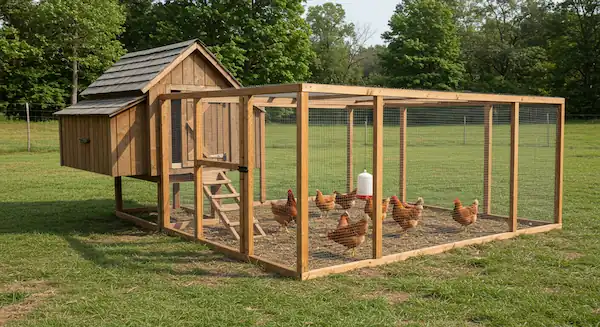
A covered run can still become repetitive during long stretches of poor weather. Use the available space by hanging treat dispensers from the roof, adding a dry dust-bath pan, placing a cardboard box with straw and treats, or installing secure perches and ladders.
A small winter enrichment station can keep these activities organized. Set aside one corner for a dust bath, perch, and rotating enrichment items rather than spreading everything randomly through the run.
Simple Winter Rotation
Keep the rotation easy enough to maintain during cold-weather chores.
| Day | Enrichment |
| Monday | Hanging cabbage |
| Wednesday | DIY treat bottle |
| Friday | Scattered scratch grains + a new object |
Swap DIY activities every few days and change larger toys about once a week. If the flock stops investigating an item, remove it and bring it back later instead of leaving it in the run indefinitely.
Safety Checklist for Chicken Toys
A chicken toy is only useful if the flock can interact with it without getting hurt. Check new toys before installation, then inspect them again as they age.
Check for Small or Breakable Parts
Look closely at beads, bells, plastic pieces, hooks, and anything that could detach during pecking. If a piece is small enough to fit inside a chicken’s beak, treat it as a potential choking hazard.
DIY treat dispensers need the same attention. Smooth the edges around drilled holes, and make sure the treats inside are an appropriate size for your birds.
Look for Sharp Edges
Run your fingers over wooden, plastic, and metal parts before putting a toy in the run. Rough wood can splinter, while worn plastic or bent metal can develop sharp points.
Sand rough edges on homemade toys and remove commercial toys once they become cracked, splintered, or damaged.
Choose Safe Materials
DIY toys should use clean materials that are suitable for animal use. Untreated wood and food-safe containers are better choices than painted, chemically treated, or unknown materials.
Avoid using pressure-treated lumber or old painted materials when making chicken toys. For commercial products, check the materials and construction before giving them to your flock.
Prevent Entanglement
Ropes, strings, chains, and hanging toys can catch feet, toes, wings, or wattles. Keep hanging parts secure and avoid unnecessary lengths of loose cord.
Check hanging toys frequently for fraying, loose knots, damaged hooks, or openings where a chicken could become trapped.
Make sure the attachment point is strong enough for the toy and the way your birds use it.
Take Extra Care with Roosters
Mirrors deserve special attention when a rooster is part of the flock. A confrontational bird may treat its reflection as another rooster and repeatedly charge or peck at it.
Watch the first few interactions closely. Remove the mirror if it causes repeated aggression or agitation. With territorial birds, spreading enrichment around the run can also reduce competition over a single toy.
Keep Treats in Check
Treat-based toys add enrichment, but they also add calories. Scratch grains, mealworms, fruit, and other extras should not replace a balanced poultry diet.
Keep treats as a small part of the diet, and make sure your flock’s main feed provides the nutrition they need. Our guide to what chickens should eat covers the basics of a balanced chicken diet.
Use treats as a small part of the activity rather than filling a toy with large amounts every day. If you use food-based enrichment frequently, account for those extras when managing the flock’s overall diet.
Our Quick Safety Check
Before we add any chicken toy to the run, we check five things:
- Small parts: Nothing loose enough to swallow.
- Edges: No sharp, cracked, or splintered surfaces.
- Materials: No questionable coatings or treated wood.
- Hardware: Secure hooks, chains, ropes, and attachments.
- Bird reaction: No trapping, panic, or aggressive behavior.
A few minutes of checking can prevent a cheap chicken toy from becoming a flock hazard.