Most people think a bee is a bee. A small flying insect. Black and yellow stripes. A painful sting if you get too close. The reality is much more complicated.
Thousands of bee species exist worldwide, and hundreds can be found across North America alone. Some live in large colonies. Others spend their entire lives alone. Some build hives in trees or wall cavities. Others tunnel into bare soil, flower beds, or lawns. Many rarely sting people. A few deserve more caution.
That difference matters. Every spring, homeowners notice small holes appearing in the ground. Gardeners watch metallic green insects moving between flowers. Parents see large fuzzy bees hovering near patios and worry about stings. In many cases, the insect is identified incorrectly.
Harmless ground-nesting bees are often treated as pests. Defensive yellow jackets are often mistaken for ordinary bees. The result is unnecessary fear, unnecessary extermination, and missed opportunities to support some of the most important pollinators in the landscape.
Learning the different types of bees makes these encounters much easier to understand. Once you know how bees nest, carry pollen, and behave around people, it becomes easier to tell a solitary mining bee from a social bumblebee or a true bee from a wasp.
This guide explores the major types of bees, the species most likely to sting, the bees that live underground, and the common bees found in Minnesota. You’ll also learn how to identify them in the yard, what role they play in pollination, and when they should be left alone.
Types of Bees: How Bees Are Actually Grouped in the Real World
Most people see bees as one category. A buzzing insect. Maybe a sting risk. Maybe a pollinator.
In reality, bees split into three very different behavioral groups. The difference isn’t just academic. It changes how they live, where they nest, and how they react when you get too close.
Once you understand this structure, lawn holes, flower visitors, and mystery insects start making a lot more sense.
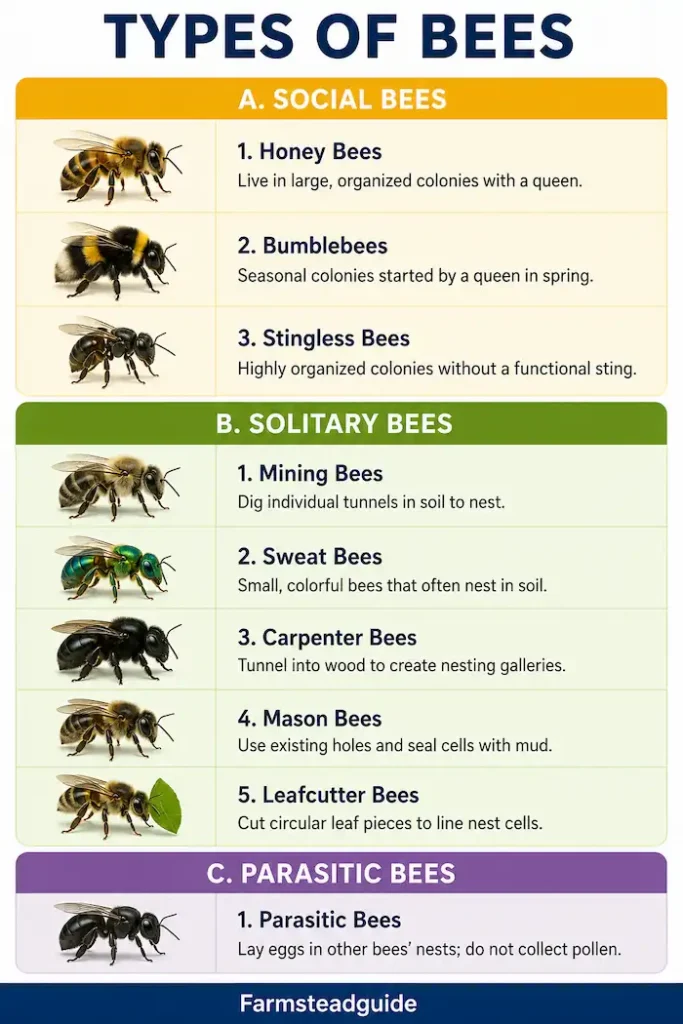
A) Social Bees (Colony-Based Species)
Social bees live in organized colonies with clear roles. One queen lays eggs. Workers gather food and defend the nest. Drones exist only for reproduction. The whole system depends on cooperation inside a shared nest.
1. Honey Bees (Apis mellifera)
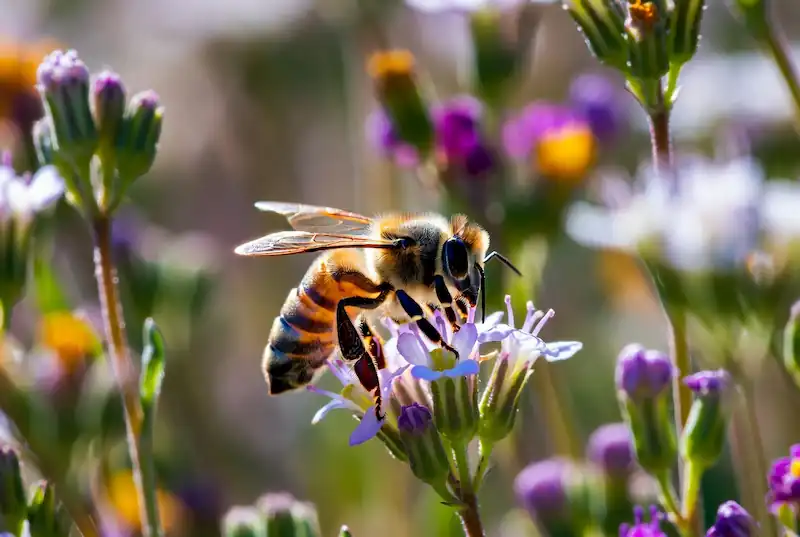
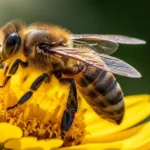
Honey bees are the most familiar example of a permanent social colony. A single hive can survive for years if conditions are stable. Inside, thousands of workers maintain brood, store honey, regulate temperature, and protect the queen.
They do not live in lawns or soil openings. Instead, they prefer enclosed cavities like hollow trees, wall spaces, or managed hives.
When you see honey bees in a garden, they are almost always foraging, not nesting. Their focus is flowers, not people. Stinging usually happens only when the colony itself is threatened or the hive entrance is disturbed.
If you’re wondering whether honey bees sting and when they become defensive, it’s important to understand how colony protection influences their behavior.
2. Bumblebees (Bombus species)
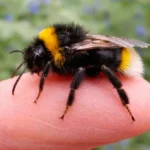
Bumblebees feel different from honey bees the moment you watch them closely. They are larger, heavier in flight, and often appear early in the season when temperatures are still low.
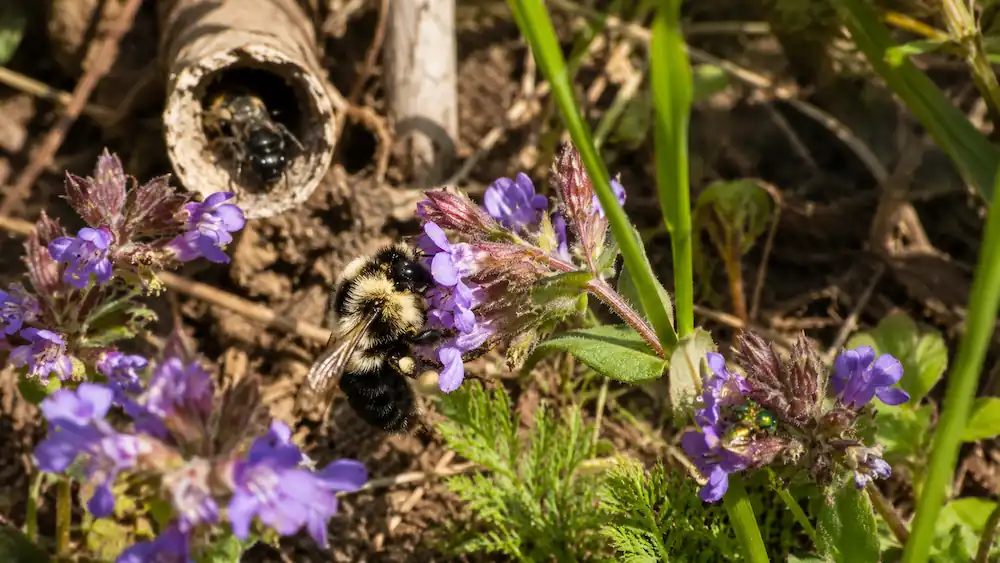
Their colonies are seasonal, not permanent. A queen starts a nest each spring, usually in an abandoned rodent burrow or thick grass tussock. By late summer, the colony declines and new queens leave to overwinter.
They can nest in or near the ground, which is why homeowners sometimes mistake them for yard pests. But their behavior is cautious. They rarely react unless the nest entrance is directly disturbed by footsteps, pets, or equipment.
3. Stingless Bees
Stingless bees exist mostly in tropical regions and are not commonly encountered in colder climates. They have a reduced sting that cannot be used for defense. Their colonies are highly organized, similar to honey bees, and they rely on resin and wax mixtures to build complex nests.
B. Solitary Bees (The Largest Group of Bees)
Solitary bees make up the majority of bee species worldwide. There is no hive, no queen, and no worker system. Each female is responsible for everything: digging or finding a nest site, collecting pollen, laying eggs, and sealing each brood cell.
This group includes many of the bees people misidentify in yards and gardens because their behavior is unfamiliar.
1. Mining Bees (Andrena species)
Mining bees are one of the first bees people notice in spring because they appear exactly when lawns are still soft from thaw.
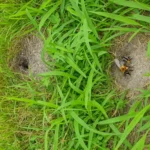
Each female digs her own vertical or slightly angled tunnel in bare or lightly vegetated soil. At the entrance, she leaves small, clean soil piles that look like miniature volcanoes or pencil pokes in the turf.
There is no guarding behavior. No shared entrance. No aggression around the nest. The soil openings are simply entry points, not defensive structures.
These bees are short-lived above ground. You typically see them in April and May, then they disappear once nesting is complete.
2. Sweat Bees (Halictidae family)
Sweat bees are small, often metallic green, blue, or bronze. They are easy to miss unless they land on skin during warm weather, which is where their name comes from.
Many species nest in loose soil, garden edges, or compacted ground where digging is easier than in dense turf. Some species are solitary. Others show a simple social structure, but nothing close to a honey bee colony.
They are strongly attracted to flowers and rarely show defensive behavior unless trapped. Most sting reports come from accidental contact rather than aggression.
3. Carpenter Bees (Xylocopa species)
Carpenter bees are large and often mistaken for bumblebees, but the difference becomes clear when you look closely. Their abdomen is smooth and shiny rather than fuzzy.
Instead of nesting in soil, they tunnel into wood. Fences, decks, and unpainted timber are common targets. The entrance holes are clean and round, drilled directly into the surface.
Carpenter bees are also frequently included in discussions about bees that sting, although the risk is often overstated. Males may hover aggressively around nesting sites, but they cannot sting. Only females possess a stinger, and they rarely use it unless they are handled or feel trapped.
4. Mason Bees (Osmia species)
Mason bees are quiet, efficient pollinators that often go unnoticed. They do not dig soil or chew wood. Instead, they use existing holes such as hollow stems or natural crevices.
Once inside, they divide the space into small chambers and seal them with mud. This is where their name comes from.
They are among the most docile bees you will encounter and are highly valuable for early-season pollination, especially in orchards and gardens.
5. Leafcutter Bees (Megachile species)
Leafcutter bees behave in a very recognizable way once you learn to spot the damage. They cut neat circular pieces from leaves and carry them back to their nests.
These nests are usually in hollow stems or pre-existing tunnels. The leaf pieces are used like lining material for each brood cell.
Despite the visible leaf damage, they are not harmful to plants in any long-term sense. They rarely occur in large enough numbers to stress healthy vegetation.
C. Parasitic Bees (Nest-Using Species)
Parasitic bees do not build nests or collect pollen for their young. Instead, they rely on the nests of other bees. Their survival strategy is simple: locate a host nest, enter it, and lay eggs in the pollen stores already collected by the host. The larvae then consume the stored food.
These bees are often called cuckoo bees because the behavior resembles cuckoo birds in other animal groups.
They do not maintain colonies, and they do not defend territory in the usual sense. Because they skip the labor of nest building, they often lack pollen-carrying structures entirely.
Why This Classification Matters in Real Yards
Most confusion happens when people assume all bees behave like honey bees.
They don’t. The bees digging in soil are usually solitary mining bees. The metallic insects on flowers are often sweat bees. The large fuzzy bee near the ground may be a bumblebee colony with a hidden entrance.
Only a small fraction of bees in any yard are actually defensive or problematic.
Once you separate bees by behavior instead of appearance, the landscape becomes easier to read, and most pest problems turn out to be pollinators doing exactly what they evolved to do.
The better approach is to look at body shape, wing patterns, pollen-carrying structures, and nesting habits. According to researchers at the University of Minnesota Bee Lab and the USGS Native Bee Inventory, these features are often the quickest way to tell one type of bee from another.
Bee vs. Wasp: Quick Identification Table
Feature
True Bees
Wasps and Hornets
Body Shape
Stocky, compact, often rounded
Slender with a narrow waist
Hair Coverage
Usually hairy for pollen collection
Mostly smooth and shiny
Waist
Broad or less obvious
Distinct wasp waist
Pollen-Carrying Structures
Scopa or pollen baskets present
Absent
Wings at Rest
Flat or tent-like over body
Folded lengthwise
Typical Colors
Brown, black, metallic green, blue, muted bands
Bright yellow-black or white-black patterns
Nest Location
Soil burrows, hollow stems, tree cavities, dead wood
Paper nests, shrubs, eaves, underground colonies
Main Food Source
Pollen and nectar
Insects, spiders, meat scraps, sugary foods
Stinger
Usually defensive and rarely used
Can sting repeatedly when threatened
Social Structure
Solitary or social depending on species
Highly social colonies
Peak Activity
Spring through mid-summer for many species
Late summer is often the most aggressive period
Minnesota Regional Native Bee Spotlight
Minnesota is not a single bee landscape. It sits where prairie grasslands, hardwood forests, wetlands, and northern boreal systems meet. That overlap creates something most states do not have: multiple bee communities sharing the same geographic space, often only a few hundred miles apart.
This is why bee identification in Minnesota is rarely simple. What is common in the south may be rare in the north, and vice versa.
Minnesota lies in an ecological transition zone where prairie gradually shifts into forest. That boundary matters more than most homeowners realize.
In open prairie regions, bees that prefer sandy, sun-exposed soil dominate. In forested areas, species adapted to shaded ground, acidic soils, and cooler spring temperatures become more common. Between these two zones, species overlap and shift constantly.
This is also why identification guides that are not region-specific often fail here. A bee that is common in southern Minnesota may not appear at all in the northern forest belt, even though both regions are only a few hours apart.
Season timing also changes. Southern areas warm earlier, which means mining bees and early spring pollinators appear sooner. Northern regions stay cold longer, delaying emergence and compressing the active season.
Twin Cities Urban Bees
In Minneapolis–St. Paul and surrounding suburbs, bee activity is shaped heavily by human landscaping.
Lawns, ornamental gardens, parks, and fragmented green spaces create a patchwork habitat. This favors adaptable species, especially those that tolerate disturbed soil and non-native plants.
Ground-nesting bees are especially visible in urban settings. Bare patches in lawns, garden edges, and even compacted soil along driveways can become nesting sites. Warm pavement and buildings also create small heat pockets, extending activity periods slightly longer than in surrounding rural areas.
In these environments, homeowners most often encounter:
Mining bees emerging in spring lawns
Sweat bees visiting garden flowers and occasionally landing on skin
Bumblebees nesting in undisturbed corners of yards or old rodent burrows
Most of these interactions are harmless, but they are often misread because urban spaces bring bees and people into closer contact than natural habitats do. Homeowners concerned about nesting activity should first learn about getting rid of ground bees so they can distinguish between beneficial native bees and situations that may require intervention.
Northern Woodland and Boreal Nesting Patterns
Northern Minnesota tells a different story. Here, cooler temperatures, acidic soils, and dense forest cover shape bee communities in a more specialized way. Ground-nesting bees still exist, but they often occupy different niches than their southern counterparts.
Soils under coniferous or mixed forests tend to be less stable and more acidic, which influences where bees choose to dig. Open sandy patches, road edges, forest clearings, and riverbanks become more important nesting sites than lawn-like habitats.
Some northern mining bees have also adapted to specific plant relationships. Willow and blueberry are especially important early-season food sources in these regions, making flowering timing critical for survival in short growing seasons.
The overall pattern is simple: fewer lawn encounters, but more specialized plant-bee relationships tied tightly to native vegetation cycles.
The 500-Species Reality
Minnesota has hundreds of native bee species. The exact number exceeds 500 recorded taxa, and that diversity continues to be refined as research expands.
For most homeowners, this level of detail is overwhelming and unnecessary. What actually matters in practice is not species identification, but behavioral grouping:
Is it nesting in soil or wood?
Is it social or solitary?
Is it defensive or non-defensive?
Is it active in spring or late summer?
These patterns are consistent enough to guide real decisions in yards, gardens, and lawns.
Researchers and field guides from institutions like the University of Minnesota Bee Lab emphasize this same point: genus-level or behavior-level identification is usually sufficient for safe, informed interaction with native bees.
Trying to identify every bee to species is not realistic in a backyard setting. Learning how bees behave in groups is.
And in most cases, that is what prevents unnecessary removal of harmless pollinators.
Frequently Asked Questions About Bees
1. What are the three main bees?
Inside a honey bee colony, there are three castes:
Queen bee: The only female that lays eggs and maintains the colony.
Worker bees: Sterile females that collect nectar and pollen, build and clean the hive, and protect the colony.
Drones: Male bees whose only role is to mate with a queen.
Each type has a specific job that keeps the colony functioning.
2. Which bee is the most common?
The most common managed bee worldwide is the Western Honey Bee (Apis mellifera), widely used in agriculture and honey production.
In the wild, the most frequently encountered bees depend on region, but the most common groups include:
Sweat bees (Halictidae): Small, often metallic-colored bees found in gardens and lawns.
Bumble bees (Bombus spp.): Large, fuzzy bees common in cooler climates and gardens.
Carpenter bees (Xylocopa spp.): Large bees that nest in wood, often seen in urban areas.
These native groups often appear more frequently in yards than honey bees.
3. What are the 7 families of bees?
All bee species are classified into seven biological families:
Apidae: Includes honey bees, bumblebees, and carpenter bees. The largest and most well-known family.
Megachilidae: Mason and leafcutter bees that carry pollen on the underside of their abdomen.
Halictidae: Sweat bees, often small and metallic, common in gardens and soil nests.
Andrenidae: Mining bees, solitary ground-nesting bees active mainly in spring.
Colletidae: Cellophane or plasterer bees that line nest cells with a waterproof coating.
Melittidae: A smaller, more specialized group, including some oil-collecting bees.
Stenotritidae: The smallest family, found only in Australia.
4. How many species of bees are there?
There are over 20,000 known bee species worldwide.
Most bees are solitary, not hive-forming insects.
Around 4,000+ species exist in the United States alone.
Only a small fraction are honey-producing bees.
This diversity includes mining bees, mason bees, sweat bees, carpenter bees, leafcutter bees, bumblebees, and many others.
5. What is the most unique bee?
One of the most unusual bees is the vulture bee. Unlike typical bees, it feeds on rotting meat instead of flowers. It uses animal protein as food for its larvae and produces a nutrient-rich substance often compared to honey. This behavior is extremely rare among bees and is found mainly in Central and South America.
David Carter, founder of Farmstead Guide, has over 20 years of hands-on homesteading experience. From raising poultry to practicing sustainable farming, he shares practical tips and insights to help others live a more self-sufficient lifestyle.