Minerals for Goats
Feeding good hay and providing fresh water are only part of keeping goats healthy. Even goats with an excellent diet can develop nutritional problems if they don’t receive the right balance of minerals. These nutrients support everything from bone development and muscle function to fertility, milk production, hoof quality, and a strong immune system. Without them, goats may not perform or thrive as expected.
Understanding basic goat behavior and breed differences helps explain why mineral requirements can vary so much from one herd to another.
Choosing a goat mineral isn’t always easy. You’ll find loose minerals, mineral blocks, salt licks, skin and coat supplements, and countless formulations designed for different regions and production goals. Knowing which products actually meet your herd’s needs can save money while preventing common nutritional deficiencies.
Drawing on my experience managing goats at Carter Farm, I’ll explain the minerals goats need, the feeding methods I’ve found most effective, the deficiency symptoms I watch for, and how I choose mineral supplements that keep my herd healthy throughout the year.
How Minerals Boost Goat Productivity and Well-Being
Minerals play a huge role in keeping goats healthy and productive.
- Growth & Development: Kids need the right minerals to grow strong bones, muscles, and organs.
- Reproduction: Adequate minerals support fertility, healthy pregnancies, and successful lactation in does.
- Immune System: Minerals strengthen the immune system, helping goats fight off diseases and recover faster.
- Overall Vitality: Proper mineral balance keeps energy levels high, coats shiny, and keeps goats active and lively.
Mineral Interactions: Antagonism & Synergy
Minerals don’t work in isolation. Some boost each other, while others can block absorption. Understanding these interactions helps keep your goats healthy and prevents hidden deficiencies.
Mineral Antagonisms indicate minerals that interfere with each other. Common mineral antagonisms include:
- High Molybdenum or Sulfur → reduces copper absorption
- Excess Iron → lowers copper and zinc uptake
- High Calcium → can interfere with manganese and zinc absorption
Mineral Synergies mean minerals that work well together. Helpful synergies are:
- Selenium + Vitamin E → strong antioxidant protection
- Calcium + Phosphorus → optimal bone growth and strength
This will be clearer to you after reading the following sections.
Loose Minerals vs. Mineral Blocks
When it comes to giving minerals to goats, most owners get stuck choosing between loose minerals and mineral blocks. Both are common options, but they don’t work the same way, and picking the wrong one can mean your goats aren’t getting what they need.
Loose Minerals
Loose minerals are usually the top choice for goats. They’re easy for goats to lick and consume in the right amounts, which helps prevent deficiencies. Because goats can adjust their intake based on their needs, loose minerals are especially useful for breeding does, growing kids, and lactating goats. The downside is they need proper feeders and protection from rain so they don’t get wasted.
1. REDMOND Goat Mineral Supplement Mix
After comparing dozens of loose goat minerals over the years, I always pay attention to three things before recommending one: the ingredient profile, how willingly goats consume it, and whether it provides the trace minerals most herds actually need. REDMOND Goat Mineral Mix (Shop on Amazon) stands out because it starts with naturally mined sea minerals rather than relying heavily on fillers.
Its formula includes more than 60 naturally occurring trace minerals and is further fortified with selenium, copper, zinc, manganese, cobalt, iodine, and vitamins A, D, and E. Those are some of the nutrients I always look for when comparing goat mineral supplements.
Unlike some inexpensive mineral mixes that rely on fillers or heavily processed ingredients, REDMOND keeps the ingredient list relatively simple by using unrefined sea salt as the foundation. One aspect I like about this formula is its higher salt-to-mineral ratio, which is intended to encourage steady free-choice consumption rather than letting minerals sit untouched.
Key Features
| Feature | Details |
|---|---|
| Mineral Type | Free-choice loose mineral in granulated form |
| Primary Base | Naturally mined unrefined sea minerals |
| Trace Minerals | Over 60 naturally occurring trace minerals plus added copper, selenium, zinc, manganese, cobalt and iodine |
| Added Vitamins | Vitamins A, D and E |
| Processing | No chemical processing or added fillers |
| Feeding Method | Designed for free-choice feeding in a covered mineral feeder |
| Suitable For | Meat goats, dairy goats, breeding does and growing kids |
| Available Sizes | Multiple bag sizes, including small and bulk options |
| Best Feature | Naturally sourced mineral blend with broad trace mineral coverage |
Pros
- Broad trace mineral profile with added vitamins.
- Granulated loose minerals are easy for goats to consume.
- Made without fillers or chemical processing according to the manufacturer.
- Uses naturally mined unrefined sea minerals.
- Available in several bag sizes for different herd sizes.
- Generally receives positive feedback for palatability.
Cons
- Premium pricing compared with some competitors.
- Not every herd accepts it equally well.
- Regional mineral deficiencies may still require additional supplementation under veterinary guidance.
Best For
- Backyard goat keepers.
- Dairy goat herds.
- Meat goat operations.
- Breeding herds needing a complete free-choice mineral.
- Owners who prefer naturally sourced mineral supplements.
REDMOND Goat Mineral Mix is one of the better premium loose mineral options available. Its naturally sourced mineral base, comprehensive trace mineral package, and granulated texture make it an appealing choice for many goat owners. While no single mineral supplement is ideal for every region or herd, this product offers a well-rounded formulation that’s worth considering if you’re looking for a high-quality free-choice goat mineral.
2. Manna Pro Goat Mineral Supplement
If you’re willing to spend a little more on a mineral supplement, Manna Pro Goat Mineral Supplement (Shop on Amazon) offers more than just a standard vitamin and mineral blend. What makes it different is its focus on both nutrition and digestive health, making it a good option for goats that need extra support during growth, breeding, or periods of stress.
Unlike many basic loose minerals that only provide trace minerals, this formula includes live microbial cultures, yeast, and fermentation products that are designed to support a healthy rumen. That’s a feature I don’t see in every goat mineral, and it’s one reason this product costs more than many competitors.
Another ingredient I appreciate is ammonium chloride. This can be especially beneficial for wethers and bucks because it helps support urinary tract health when combined with proper feeding management. It’s a thoughtful addition that saves many owners from buying a separate supplement.
The mineral package is also well-rounded, providing calcium, phosphorus, magnesium, copper, zinc, manganese, selenium, cobalt, iodine, and vitamins A, D3, and E. Chelated forms of several minerals are included as well, which may improve mineral availability compared to products that rely solely on inorganic sources.
If you’re looking for more than a basic mineral supplement, Manna Pro is one of the more complete formulas available and justifies its premium price through its added digestive support and urinary health ingredients.
Key Features
| Feature | Details |
|---|---|
| Mineral Type | Loose mineral supplement |
| Digestive Support | Contains yeast cultures, probiotics, and fermentation products to support rumen function |
| Urinary Health | Includes ammonium chloride to help support urinary tract health, particularly in male goats |
| Mineral Blend | Provides calcium, phosphorus, magnesium, copper, zinc, selenium, manganese, cobalt, iodine, and potassium |
| Vitamin Fortification | Enriched with vitamins A, D3, and E |
| Chelated Minerals | Includes several amino acid chelated minerals for improved bioavailability |
| Feeding Method | Can be offered free choice or mixed with feed according to the manufacturer’s directions |
| Bag Size | 8-pound bag |
| Best Feature | Combines complete mineral nutrition with digestive and urinary health support |
Pros
- Includes probiotics, yeast cultures, and fermentation products for digestive support.
- Contains ammonium chloride to support urinary tract health.
- Comprehensive vitamin and mineral profile.
- Uses several chelated minerals for improved absorption.
- Highly palatable according to many customer reviews.
- Suitable for growing, breeding, and mature goats.
Cons
- More expensive than many standard loose mineral supplements.
- Available primarily in an 8-pound bag, which may not be ideal for very large herds.
What Makes It Worth the Higher Price?
Many loose minerals simply supply essential vitamins and trace minerals. Manna Pro goes a step further by combining three areas of support in one product:
- Complete mineral nutrition with essential macro and trace minerals.
- Digestive support through yeast cultures, probiotics, and microbial fermentation products that help maintain a healthy rumen.
- Urinary health support with added ammonium chloride, an ingredient especially valued by owners of wethers and bucks that are more prone to urinary calculi.
Because of these extra functional ingredients, you may not need to purchase separate digestive supplements or urinary health additives, which can help offset the higher upfront cost.
Best For
- Growing kids.
- Breeding bucks and wethers.
- Dairy and meat goat herds.
- Goats on grain-based diets.
- Owners who want digestive support in addition to a mineral supplement.
Manna Pro Goat Mineral Supplement is a premium option that offers more than basic mineral replacement. Its inclusion of probiotics, yeast cultures, chelated minerals, and ammonium chloride makes it a more comprehensive supplement than many competitors. While it carries a higher price tag, the added digestive and urinary health benefits make it a worthwhile investment for goat owners looking for an all-in-one nutritional supplement.
3. Manna Pro Goat Skin & Coat Supplement
If your goats already have access to a good loose mineral but their coats still look dull or they struggle with dry skin, Manna Pro Goat Skin & Coat Supplement (Shop on Amazon) is worth considering. Instead of focusing on complete mineral nutrition, this product is designed to improve coat quality, skin health, and hoof condition.
The standout ingredient is ground flaxseed, which provides natural omega-3 fatty acids to help nourish the skin and promote a softer, shinier coat. It also contains biotin, zinc methionine, and vitamins A and E, nutrients that play an important role in healthy skin, strong hooves, and hair growth.
Unlike free-choice minerals, this supplement is intended to be mixed with your goat’s regular feed. Many owners report that their goats eat it readily, and several reviews mention noticeable improvements in coat shine, reduced itching, and healthier-looking hair after a few weeks of consistent use.
It’s also a popular option for show goats, where a glossy coat and overall appearance are especially important. While it is more expensive than standard mineral supplements on a per-pound basis, it’s formulated for a different purpose and is meant to complement, not replace, your regular mineral program.
Mineral Blocks
Mineral blocks, on the other hand, are harder and last longer, but goats often can’t lick enough from them to meet their mineral needs. Blocks may work better for animals like cattle, but goats tend to under-consume minerals from blocks. They can be useful in very limited situations or as a backup, but they shouldn’t be the main mineral source for most herds.
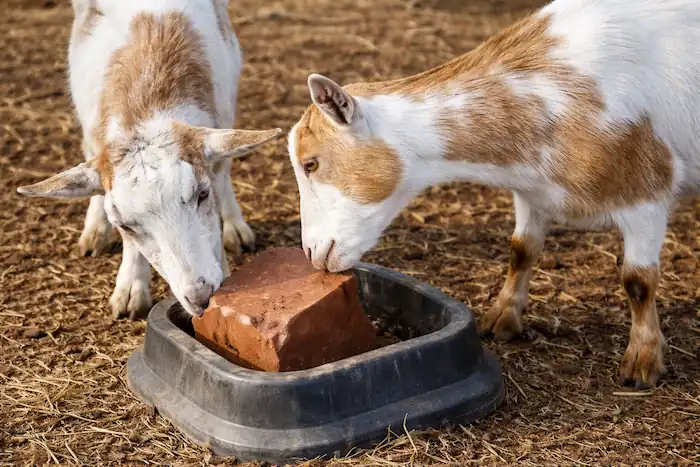
4. REDMOND Goat Mineral Rock on a Rope
Not every goat owner wants to keep a mineral feeder full of loose minerals, especially if goats spend most of their time outdoors. That’s why I decided to try the REDMOND Goat Mineral Rock on a Rope (Shop on Amazon) with my pygmy goats. I wanted something that could stay clean, handle the weather, and give the goats access to minerals whenever they wanted.
The hanging rope turned out to be one of my favorite features. Instead of sitting on the ground where dirt, bedding, or manure could contaminate it, I simply hung the mineral rock inside the shelter. My goats quickly figured out how to use it, and I didn’t have to worry about constantly cleaning or replacing a mineral pan.
What makes this product different from many standard salt blocks is that it’s made from naturally mined sea minerals containing more than 60 naturally occurring trace minerals. It isn’t packed with artificial colors or unnecessary fillers, which is something I always look for when buying supplements for my herd.
I also like that the mineral rock lasts much longer than loose minerals. My pygmy goats visited it several times throughout the day instead of consuming a large amount all at once. That made it a low-maintenance option between feeder refills.
That said, I wouldn’t rely on this as the only mineral source for every herd. Like most mineral rocks, intake is naturally lower than with loose minerals because goats can only lick the surface. I see it as an excellent supplement or a convenient option for goats on pasture, but I still prefer offering loose minerals free choice whenever possible.
Overall, this has become one of the easiest mineral products to keep available year-round, especially for smaller breeds like pygmy goats.
Key Features
| Feature | Details |
|---|---|
| Product Type | Hanging mineral rock with rope |
| Mineral Source | Naturally mined sea mineral deposit |
| Trace Minerals | Contains over 60 naturally occurring trace minerals |
| Artificial Additives | No fillers, artificial colors, or chemical processing |
| Installation | Ready to hang inside a barn, shelter, or pasture |
| Weather Resistance | Stays cleaner than ground-placed mineral blocks |
| Suitable For | Goats of all breeds, especially pasture-raised herds |
| Maintenance | Long-lasting and requires very little upkeep |
Pros
- Easy to hang and keeps the mineral off the ground.
- Durable enough for outdoor use.
- Made from natural sea minerals.
- Contains over 60 trace minerals.
- Lasts much longer than many loose mineral products.
- Requires very little maintenance.
Cons
- Goats generally consume less from a mineral rock than from loose minerals.
- Not the best choice if you’re trying to increase mineral intake quickly.
- Some goats may still prefer loose minerals.
Best For
- Pygmy goats and Nigerian Dwarf goats.
- Goats kept on pasture.
- Owners wanting a low-maintenance mineral option.
- Small backyard herds.
- Providing an additional mineral source alongside loose minerals.
5. UMAID Himalayan Salt Lick on Rope
Unlike formulated mineral blocks that are fortified with specific vitamins and trace minerals, the UMAID Himalayan Salt Lick (Shop on Amazon) takes a much simpler approach. It’s a solid block of 100% natural Himalayan salt, making it a good option for goats that simply need continuous access to salt rather than a complete mineral supplement.
The biggest difference is the ingredient list. There isn’t one long list of added minerals, flavors, or preservatives. The block is carved from natural Himalayan rock salt, which naturally contains dozens of trace minerals along with the sodium and chloride goats need for hydration, muscle contractions, and normal nerve function.
Because it’s made from a solid piece of rock salt instead of compressed material, it also stands up well to daily use. Goats gradually wear down the surface over time, so replacement is less frequent than with some softer pressed salt blocks.
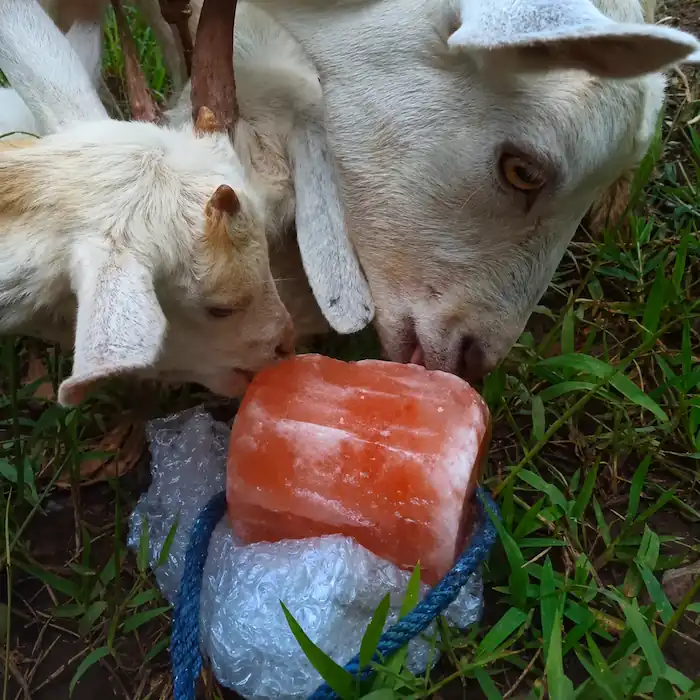
The included rope makes installation simple in a barn, shelter, or pasture, and hanging the block helps reduce contamination from mud and bedding. For herds that spend a lot of time outdoors, this makes it easier to keep salt available throughout the year.
That said, this product fills a different role than a balanced loose mineral. It supplies salt and naturally occurring trace minerals, but it isn’t formulated to meet a goat’s complete mineral requirements. Goats still need a quality loose mineral that provides nutrients such as copper, selenium, zinc, and added vitamins in the correct amounts.
Key Features
| Feature | Details |
|---|---|
| Product Type | Natural Himalayan salt lick |
| Composition | 100% Himalayan rock salt |
| Naturally Occurring Minerals | Up to 84 trace minerals |
| Primary Nutrient | Sodium and chloride for electrolyte support |
| Mounting | Pre-attached hanging rope |
| Weather Performance | Solid rock construction resists rapid wear outdoors |
| Suitable For | Goats, cattle, horses, deer, and other livestock |
| Ideal Use | Supplemental salt source alongside a balanced mineral program |
Pros
- Made from a single natural ingredient with no additives.
- Provides a reliable source of sodium and chloride.
- Solid rock construction lasts longer than many pressed blocks.
- Easy to hang in barns or pasture shelters.
- Suitable for multiple livestock species.
Cons
- Not formulated to meet a goat’s complete mineral requirements.
- Doesn’t replace a balanced loose mineral.
- Natural mineral content can vary slightly from one block to another.
Best For
- Goat owners looking to provide a dedicated salt source.
- Pasture-based herds.
- Mixed livestock farms.
- Goats that already receive a complete loose mineral.
Methods of Giving Minerals to Goats
Goats need minerals, but how you give them is the main point. There are several ways to provide minerals, each with its pros, cons, and best practices. Let’s go through some of those that are mostly adopted by goat experts.
1. How Free-Choice Feeders Let Goats Self-Regulate
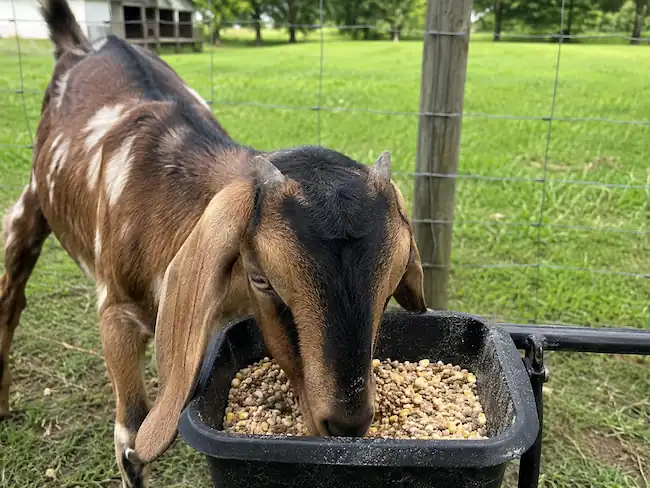
Free-choice feeding is the method I recommend for most goat owners. Instead of measuring minerals every day, you simply keep a loose mineral available at all times and let your goats decide how much they need. Healthy goats are surprisingly good at regulating their mineral intake, especially when they have continuous access to a balanced goat mineral.
This approach works particularly well if your herd includes kids, breeding bucks, pregnant does, and lactating goats, since their nutritional requirements vary throughout the year. Rather than trying to feed every animal the same amount, each goat can consume minerals according to its own needs.
The biggest challenge with free-choice feeding is keeping the minerals clean and dry. Moisture, manure, hay, and bedding can quickly contaminate an open container, causing minerals to cake together or go to waste. I’ve found that a covered or wall-mounted trough helps reduce waste and keeps minerals much more appealing to the goats.
Recommended Mineral Feeder
To make free-choice feeding more effective, I recommend using a dedicated mineral feeder instead of an open bucket or feed pan. The product I use is the Little Giant Animal Mineral Feeder (Shop on Amazon) because it was specifically designed for livestock minerals and supplements.
The feature that stands out most is its two-compartment design. I like using one compartment for loose goat minerals while keeping baking soda or another supplement in the second compartment. This setup keeps everything organized and allows goats to choose what they need without mixing supplements together.
The feeder is made from DuraFlex plastic, which is resistant to cracking, UV damage, and everyday wear. It mounts securely to a wall or fence, keeping minerals off the ground where they’re less likely to become contaminated with bedding, manure, or rainwater.
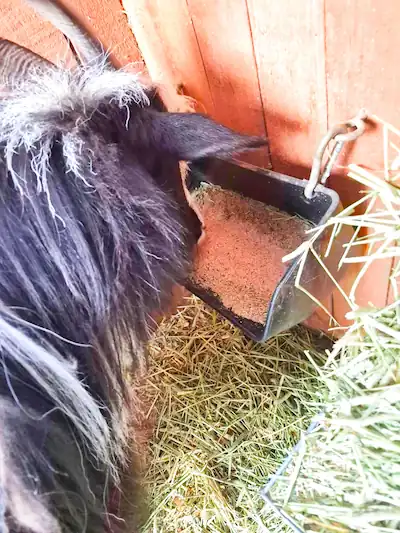
Although it holds 3.5 quarts, I still recommend checking it regularly and refilling it with fresh minerals as needed. Clean, dry minerals are far more attractive to goats than minerals that have become damp or contaminated.
Why I Recommend It
- Specifically designed for livestock minerals and supplements.
- Two separate compartments for minerals, baking soda, or other supplements.
- Wall-mounted design keeps minerals cleaner.
- Durable UV-resistant plastic suitable for indoor and outdoor use.
- Helps reduce mineral waste compared with open containers.
- Works well for backyard herds as well as larger goat operations.
For goat owners who feed loose minerals free choice, this is one of the most practical feeders available because it solves the biggest problem with mineral feeding: keeping supplements clean, dry, and easily accessible.
Another option I like is the Tiflev Hanging Livestock Feeder Trough (Shop on Amazon). Although it’s marketed primarily as a feed and water trough, its 3.5-quart capacity and sturdy hanging design also make it practical for holding loose goat minerals. Mounting the trough above ground keeps minerals cleaner than using a bucket on the floor, and the durable plastic construction holds up well in daily barn use.
2. Mixing Minerals into Feed
Another way to provide minerals is by mixing them directly into feed or grain. This method guarantees that each goat consumes a consistent amount, which is particularly useful for targeted needs like growing kids or lactating does. By controlling the mix, you can make sure every goat gets the nutrients it requires.
However, miscalculating the mix can lead to over- or under-supplementation. To avoid problems, it’s important to carefully calculate the mineral amount based on the goats’ daily feed intake. When done correctly, this method provides reliable nutrition for the whole herd.
3. Targeted Mineral Feeding Using Boluses and Injections
For goats with severe deficiencies or when precise dosing is needed, mineral boluses or injections are effective solutions. These methods allow you to deliver a specific amount of minerals directly to an individual goat, quickly correcting imbalances.
While this is a very precise way to supplement, it comes with drawbacks. Boluses and injections are invasive and only provide short-term correction. These must be administered under veterinary guidance. They are best used for individual animals with clear deficiencies rather than for routine herd-wide supplementation.
4. Administering Water-Soluble Minerals
Water-soluble minerals are an easy and convenient way to support an entire group of goats as they are added to drinking water. This method works well for short-term supplementation, such as during stress, illness or breeding periods, when goats may need a temporary boost.
The challenge with water-soluble minerals is that it’s difficult to control how much each goat consumes. And some waste is inevitable due to evaporation or spillage. Despite this, it’s a simple option for providing quick mineral support to multiple goats at once.
Choosing the Right Method
Each method of providing minerals has its strengths and limitations. I personally prefer free-choice feeding for daily maintenance because it lets goats self-regulate and take what they need naturally. Mixed feed works well to ensure consistent intake for the whole herd.
Boluses and injections, I only administer them when I have to deal with severe deficiencies in individual animals. Water-soluble minerals are useful for short-term support. By observing my goats, understanding their specific needs, and combining these methods wisely, I can keep my herd healthy, productive, and well-nourished.
Macro vs. Trace Minerals
Goat minerals usually fall into two main groups, and the difference between them comes down to how much your goats actually need.
Macro minerals are the big players. Goats need these in larger amounts every day because they support basic things like bone strength, muscle function, and overall body structure.
Trace minerals, on the other hand, are needed in tiny amounts, but they’re equally important. Even though goats only require milligrams or micrograms of them, these minerals keep key processes running smoothly, such as metabolism, immunity, and reproduction.
Both types work together behind the scenes, and missing even one can throw everything off. You have to understand this, as it clears up a lot of doubt and makes it easier to know what your goats actually need to stay healthy.
Macro-Minerals
Calcium & Phosphorus
Calcium and phosphorus are the foundation of your goats’ bodies. They build strong bones, help muscles contract, support nerve function, and even play a role in milk production. Kids lacking these minerals can develop rickets, while adults may show weak bones, lameness, or lower milk yield. You can find them in legumes, grains (for phosphorus), and mineral supplements.
One important thing to remember: the Ca:P ratio matters a lot. For goats, the ideal calcium to phosphorus (Ca:P) ratio in their total diet is generally in the range of about 1.5:1 to 2:1, meaning goats should get roughly 1.5 to 2 times more calcium than phosphorus overall.
Keep the following points in mind regarding Ca:P ratio.
- The ratio should never drop below about 1.2:1 because too much phosphorus relative to calcium can increase the risk of urinary stones, especially in males.
- A 2:1 ratio is often recommended for growing kids and lactating does because they have higher calcium needs.
- This ratio applies to the total diet, including forage, grain, and supplements, not just the mineral mix.
Sodium & Chlorine
Sodium and chlorine are essential electrolytes that help goats maintain proper hydration, fluid balance, nerve function, and nutrient absorption. When goats don’t get enough of these minerals, they may show signs such as unusual licking of soil, rocks, or other objects (pica), reduced appetite, weight loss, and dehydration. You can provide sodium and chlorine through salt blocks, free-choice loose minerals, or commercial feeds fortified with these essential minerals.
Potassium, Magnesium & Sulfur
- Potassium: Keeps nerves and muscles working smoothly and maintains acid-base balance. Deficiency is rare but can happen in severe diarrhea.
- Magnesium: Powers enzyme activity, supports nerves and muscles, and helps bones develop. A lack can lead to tetany-like symptoms on lush pastures.
- Sulfur: Needed for essential amino acids and vitamins, plus it helps goats digest fiber in the rumen. Deficiency shows up in poor wool or hair growth and sluggish digestion.
Suggested Mineral Amounts for Goats
| Mineral | Suggested Range (Approx.) |
| Calcium (Ca) | 0.30 – 0.80 % |
| Phosphorus (P) | 0.25 – 0.40 % |
| Magnesium (Mg) | 0.18 – 0.40 % |
| Potassium (K) | 0.80 – 2.00 % |
| Sulfur (S) | 0.20 – 0.32 % |
| Sodium (Na) | 0.20 % |
| Chloride (Cl) | 0.20 % |
These ranges are suggested for general goat health; requirements can vary by age, production stage, and forage quality.
Trace Minerals
Copper & Zinc
- Potassium: It keeps nerves and muscles working smoothly and maintains acid-base balance. Deficiency is rare but can happen in severe diarrhea.
- Magnesium: Mg powers enzyme activity, supports nerves and muscles and helps bones develop. A lack can lead to tetany-like symptoms on lush pastures.
- Sulfur: Sulfur is needed for essential amino acids and vitamins, plus it helps goats digest fiber in the rumen. Deficiency shows up in poor wool or hair growth and sluggish digestion.
Selenium & Iodine
Selenium is a powerful antioxidant, crucial for immune health, muscles and reproduction. Low selenium can cause White Muscle Disease in baby goats or retained placentas in does.
Iodine is needed for thyroid hormones and metabolism. Watch for goiter, weak kids, or poor reproductive performance if levels are off. Remember, soil selenium and iodine levels vary by region.
Cobalt, Manganese, Iron & Molybdenum
- Cobalt: Needed to make Vitamin B12 in the rumen. Lack of cobalt looks like B12 deficiency: anemia and wasting.
- Manganese: Supports bones, reproduction and enzymes. Deficiency can cause poor reproduction and skeletal issues.
- Iron: Part of hemoglobin that carries oxygen. Deficiency often comes from parasites and leads to anemia.
- Molybdenum: Helps with enzymes, but too much can block copper absorption.
Keep an eye on real-world signs. For example, dull coats, weak kids, lameness, or poor growth. These clues help you catch deficiencies early before they become serious.
Trace Minerals Amount (ppm — Parts Per Million)
| Mineral | Suggested Range (ppm) |
| Iron (Fe) | 50 – 1000 ppm |
| Copper (Cu) | 10 – 80 ppm |
| Cobalt (Co) | 0.1 – 10 ppm |
| Zinc (Zn) | 40 – 500 ppm |
| Manganese (Mn) | 0.1 – 3 ppm |
| Selenium (Se) | 0.1 – 3 ppm |
| Molybdenum (Mo) | 0.1 – 3 ppm |
| Iodine (I) | 0.5 – 50 ppm |
Ranges vary by production stage, maintenance, growth, pregnancy, or lactation and should be adjusted with veterinary or extension guidance.
Spotting Mineral Deficiencies in Goats
Minerals are small but powerful players in goat health. When goats don’t get enough of the right minerals, the effects can be subtle at first. A dull coat, low energy, or unusual behaviors. But these issues can quickly escalate if you don’t address them. By understanding the signs and linking them to specific mineral deficiencies, you can take action early and prevent bigger problems.
When goats lack essential minerals, they may start eating toxic plants or objects, which increases the risk of accidental poisoning from toxic plants commonly found around farms and pastures.
Mineral imbalances can sometimes show up as boredom-driven behaviors, making enrichment tools and safe goat toys helpful in reducing unwanted chewing and abnormal licking habits.
Behavioral Clues
Sometimes mineral issues aren’t obvious, so you’d have to keep an eye on your goats every day.
- Lethargy or low activity: Goats may appear tired or uninterested in feeding and playing. This is often linked to magnesium, copper, or selenium deficiencies, which affect energy metabolism and muscle function.
- Pica (eating non-food items): Chewing on soil, wood, or other objects can indicate a phosphorus deficiency, as goats instinctively seek missing nutrients.
Physical Signs
Mineral shortages often show up in the body’s appearance. Below are some most apparent symptoms.
- According to a research published by Cornell University Cooperative Extension, a dull, faded, or rough coat may point to copper or zinc deficiencies, which affect pigmentation, skin health, and hair quality.
- Brittle or cracked hooves are commonly caused by zinc deficiency.
- Gums or inner eyelids may look pale if goats are experiencing copper or iron deficiency, leading to anemia.
- Calcium and phosphorus shortages can result in fragile bones, skeletal deformities, or joint swelling.
- Often associated with low magnesium or calcium, which are crucial for proper nerve and muscle function.
Reproductive and Growth Concerns
Minerals are essential not just for general health but also for reproduction and proper growth in goats. A lack of important nutrients can have noticeable effects on fertility, kidding and the development of kids. For example, selenium deficiency can lead to problems such as poor conception rates or retained placentas, highlighting its essential role in reproductive efficiency, as noted by the University of Wisconsin Extension.
Young goats can also be affected when minerals like phosphorus and magnesium are insufficient, and when copper and zinc levels are low. These deficiencies can slow growth, weaken bones and impair overall development, resulting in smaller or less robust kids.
In lactating does, inadequate calcium can reduce milk production, which directly impacts the nutrition and growth of baby goats. Ensuring the proper balance of these minerals supports not only healthy kids but also more productive and fertile does.
Practical Diagnostic Approaches
While careful daily observation can give early clues, it’s not enough to fully understand your goats’ mineral status. Confirming deficiencies often requires targeted testing to see what your herd is actually receiving and absorbing.
Forage analysis is a key first step. By testing hay, pasture or silage, you can determine the exact mineral content available in the feed your goats consume, ensuring that their diet meets their nutritional needs.
Soil testing adds another layer of insight. Knowing the mineral composition of your pasture or grazing land helps predict the nutritional quality of the forage grown there, allowing you to identify potential gaps before they affect your herd.
For precise confirmation, blood and tissue tests performed by a veterinarian are invaluable. These tests can detect specific mineral deficiencies or toxicities, providing actionable information to guide supplementation and herd management.
The Dangers of Mineral Toxicity
No doubt, minerals are essential for goat health, but too much of a good thing can be dangerous. Some minerals, like copper and selenium can become toxic if over-supplemented. Certain breeds are more sensitive than others. For example, Angoras and Pygmies are particularly prone to copper toxicity. Knowing the risks helps you keep your goats safe while still giving them the nutrients they need.
Recognizing Signs of Toxicity
Mineral toxicity can show up in different ways. Sometimes it happens suddenly, with severe reactions like sudden death or extreme neurological problems. Other times, it develops slowly, causing symptoms such as jaundice, lethargy, loss of appetite or unusual behavior. Paying attention to these warning symptoms can save lives.
How to Prevent it?
The best way to avoid toxicity is careful management.
- Always follow product instructions and don’t guess the amount.
- Keep supplements out of reach so goats can’t overconsume by mistake.
- Watch how much free-choice mineral your goats are actually eating. Some goats may lick more than others, so keep an eye on them.
A little attention goes a long way. With the right precautions, you can give your goats the minerals they need without putting them at risk.
Choosing the Right Commercial Mineral Mix for Your Goats
Picking the right mineral mix can be confusing but understanding the label makes it easier. Look for macro-minerals like calcium, phosphorus, salt, magnesium, sulfur, and potassium, and trace minerals like copper, zinc, selenium, iodine, cobalt, manganese, and iron. Many mixes also include vitamins A, D, and E. Knowing what’s in the mix helps you choose an effective supplement without overspending.
Since minerals work hand in hand with daily feed intake, knowing what goats eat and how their diet is balanced is essential for preventing deficiencies and supporting proper growth.
Make sure the mix is designed for goats and suited to your region, since soil deficiencies vary. Avoid using cattle or sheep minerals. Also, consider the form: loose minerals, blocks, or boluses and pick one that fits your herd’s needs and management style.
Watch out for common mistakes. Don’t assume one “all-in-one” mix works for every situation, and don’t forget to account for minerals in the water your goats use. Stay updated on formulations and check reliable sources to ensure you’re giving the right balance.