What Does a Quail Look Like?
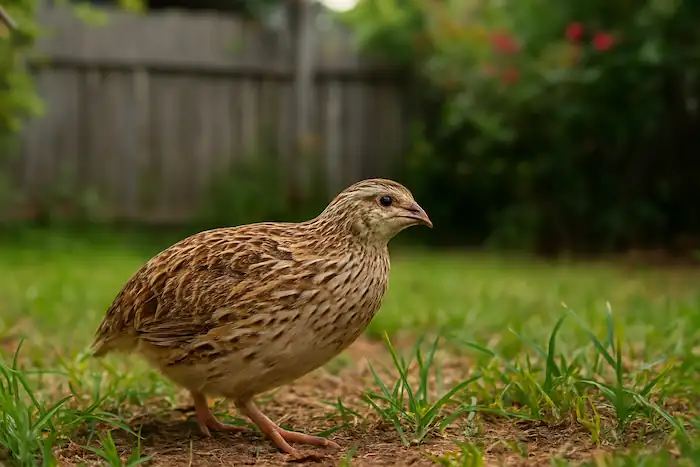
Quails are fun to watch and easy to love, but they can be tricky to identify. Many people also get confused when trying to tell a male from a female, or a young quail from an adult. A quail is a small, round bird with a short tail, brown or gray feathers, and patterns that help it blend into grass and bushes. Many types look very similar, and their colors change by age and gender. Even experienced bird lovers sometimes get it wrong.
Understanding the General Characteristics of Quail
What makes a quail a quail?
According to ornithologists (bird experts) at the Cornell Lab of Ornithology, quails are compact, ground-dwelling birds with short wings, strong legs, and camouflaged feathers. These modifications help them stay hidden in grass and brush.
They live mostly on the ground and like to run more than fly. Their short and rounded wings help them burst into the air for a quick escape.
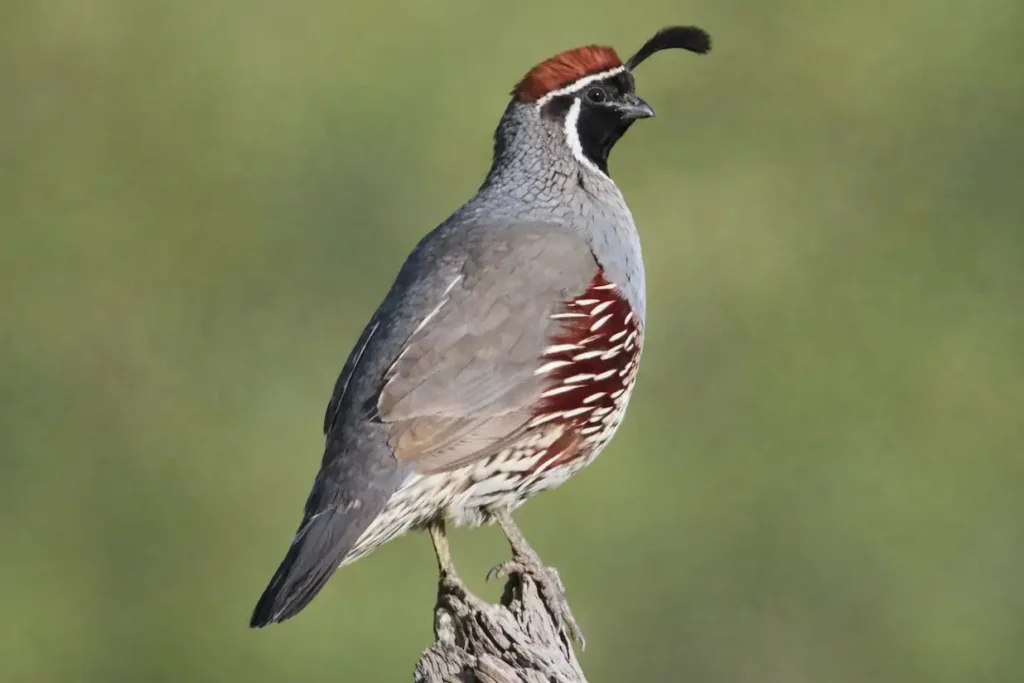
Their strong legs and feet are made for scratching the soil and running fast. Their neck and tail are short, giving them a compact look. Most quails have brown, gray or black feathers with busy patterns that help them blend into their surroundings.
Average size and weight
Most quails are about 6 to 12 inches long. That is around the length of a small ruler. Their weight usually falls between 5 and 14 ounces. Some species are lighter, while others are a bit heavier, but most stay in this range.
If you’re interested in keeping quail yourself, our detailed guide on how to raise a quail walks you through housing, care, and daily management step by step.
Key Features for Accurate Quail Identification
Head markings. Your first big clue
The head is one of the best places to start when trying to identify a quail. Many quail species have clear face patterns that help you tell them apart. This is also useful for spotting the difference between males and females.
Look closely at things like eye stripes, lines on the cheeks, and marks on the throat. Some quails have dark lines that look like a mustache. Others have bright or dark patches around the eyes.
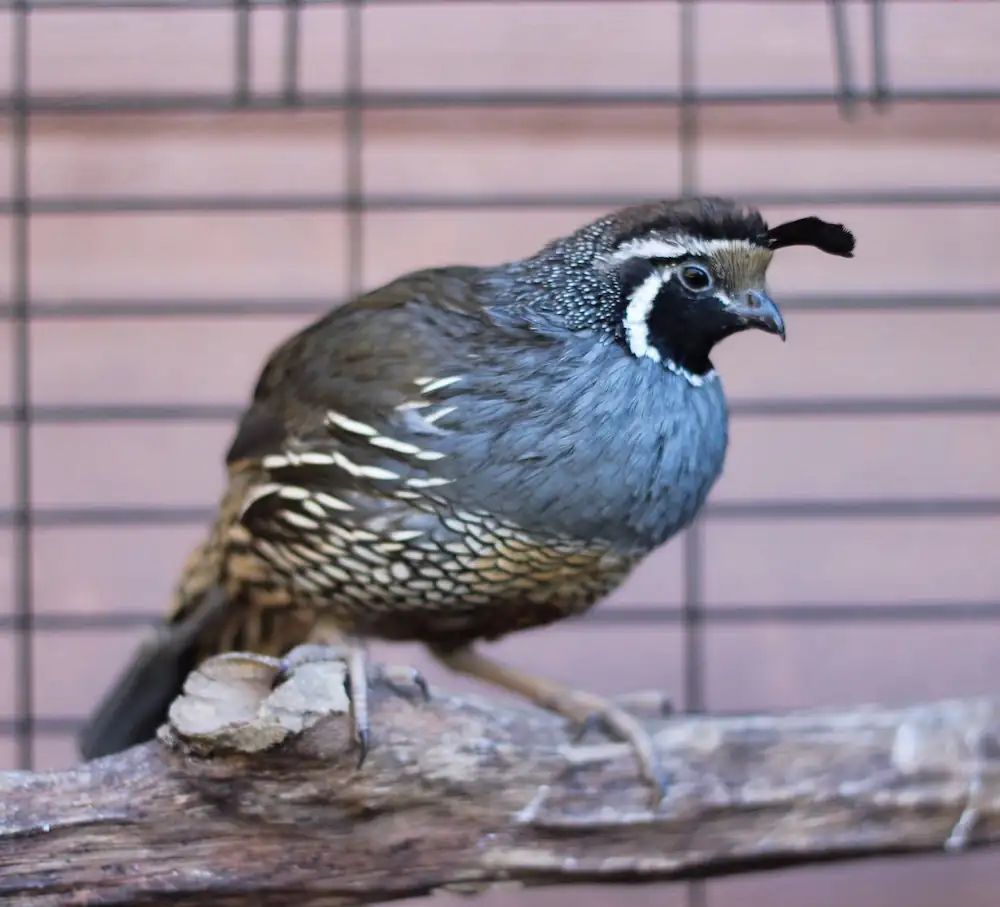
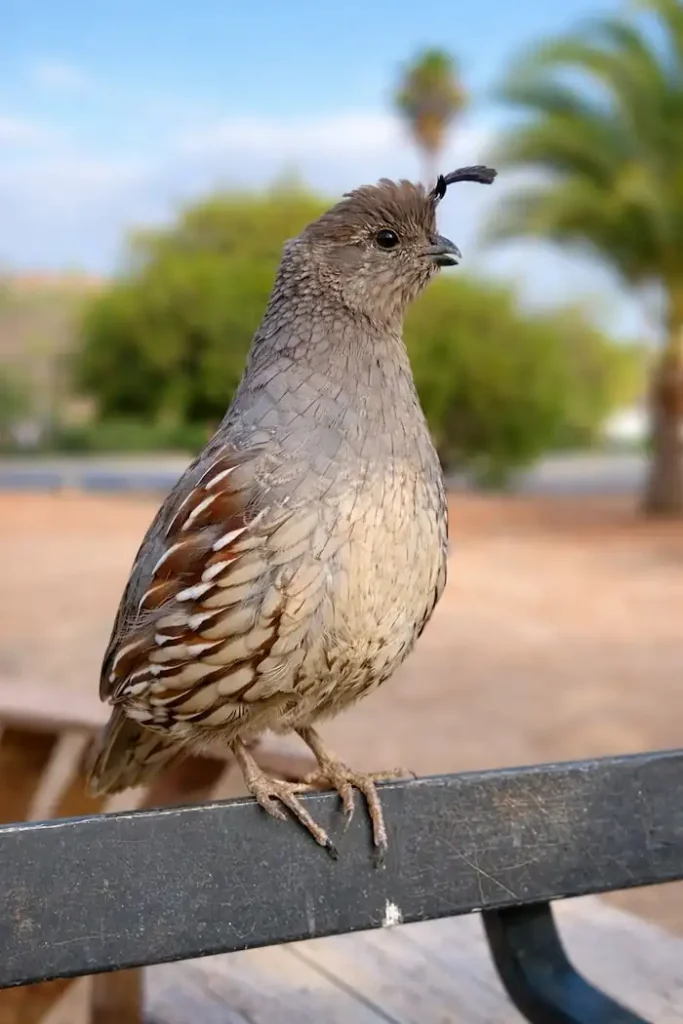
Some quails also have a crest or plume on their head. For example, California Quail have a curved plume that points forward. Gambel’s Quail have a teardrop-shaped crest.
The beak also matters. Pay attention to its size, shape and color. Some bills are dark, some are yellow, and some have two colors.
Body feathers. Patterns and colors
Quails’ chests and bellies often show clear patterns. You may see spots, stripes, scales, or solid-color patches. For example, Bobwhites have a white chest. Gambel’s Quail often show a dark belly patch.
Check the sides of the body too. These areas may have bars, spots, or lines that help with identification.
The back and wings usually have mixed colors and patterns. These help the bird blend into the grass and dirt. This is why quails are hard to see.
The tail is short and not very noticeable, but its length and pattern can still offer small clues.
Legs and feet
Quails have strong legs with no feathers on them. The leg color can vary and may look gray, yellow, or light brown.
Common Quail Species and What They Look Like
Below are some well-known quail species and the easiest ways to recognize them.
1. Northern Bobwhite
Male
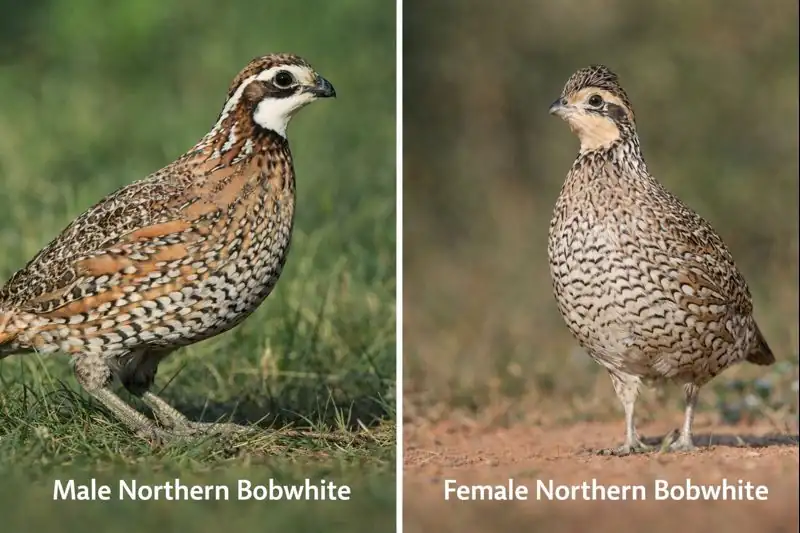
Male Northern Bobwhites have a bright white throat and a white line above the eye. These white areas are edged with black, which makes the face stand out. The top of the head is reddish brown, and the body is a mix of browns that help it blend into the ground.
Female
Females look very similar but with softer colors. Instead of bright white, the throat and eye stripe are more tan or buff colored.
Juvenile
Young bobwhites are smaller and duller. Their face markings are faint and not clearly defined. The boldface pattern is a big clue. Many people also recognize this bird by its famous “bob-WHITE” call.
2. California Quail
Male
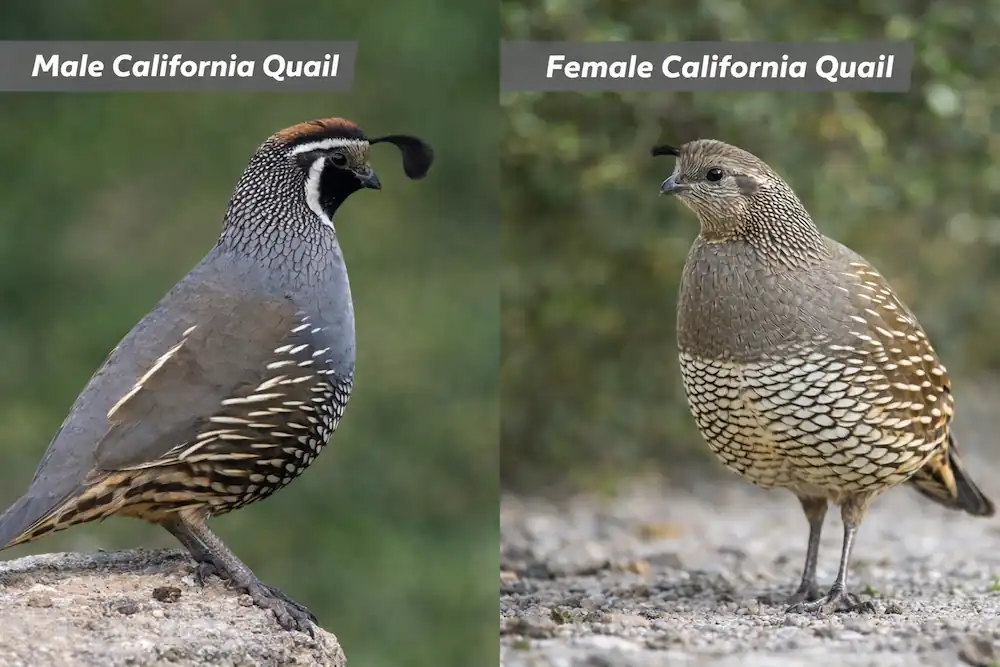
Male California Quail are easy to spot because of the black plume on their head that curves forward. Their faces are mostly black, with a white border. The belly has a scaly look with a rich chestnut patch.
Female
Females have the same basic look but with lighter colors. The plume is smaller, the face markings are softer, and the belly pattern is less bright.
Juvenile
Young birds look plain. The plume is small or missing and their feather patterns are not fully formed. Look for the teardrop-shaped plume and the scaly belly. Their call, which sounds like “chi-CA-go,” is also a helpful clue.
3. Gambel’s Quail
Male
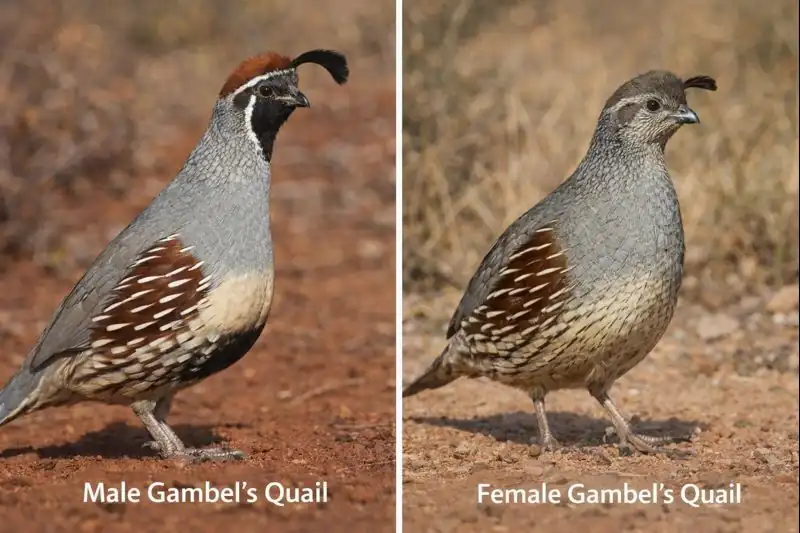
Male Gambel’s Quail have a teardrop-shaped black plume on their head. Their face and throat are black with a white outline. The sides of the body are chestnut with white streaks, and there is a clear black patch on the belly.
Female
Females are more muted in color. The plume is smaller, the head looks more gray, and the black belly patch is missing.
Juvenile
Young Gambel’s Quail do not have a clear plume or strong face markings. Their colors are dull and plain. The plume and the male’s black belly patch are key signs. These birds are also common in dry, desert areas.
4. Common Quail
Male
Male Common Quail have brown, streaked feathers. Many show a dark line through the eye and a pale throat with a dark mark or dark chin.
Female
Females look similar but usually lack the bold throat markings. Their colors are often lighter.
Juvenile
Young birds look almost the same as females, but with even softer, less distinct markings. This quail is small and often hard to see. It is usually noticed first by sound. Its call is often described as “wet-my-lips.”
Male vs. Female Quail
Telling male and female quail apart can be confusing, but there are a few simple things that really help. In most quail species, males stand out more, while females are softer in color.
A) Feather Color and Patterns
Male quail usually have brighter colors and stronger patterns. Their feathers may show clear contrasts, especially on the face, chest, or sides.
Females tend to look duller. Their colors blend better with the ground, helping them stay hidden while nesting.
B) Head Markings and Crests
The head is often the easiest place to look. Males usually have bolder face markings like darker masks or sharper stripes. If the species has a crest or plume, it is often larger and more noticeable in males. Females may still have a crest, but it is smaller and lighter.
C) Body Size and Shape
The difference is not always obvious, but males can be slightly bigger or look a bit more solid than females. This varies by species and is not always a reliable clue on its own.
D) Sounds and Calls
Sound is a big help when spotting quail. Males are usually the ones calling, especially during breeding season. Their calls are louder and more noticeable, and many people hear a quail before they ever see it.
Juvenile vs. Adult Quail
Quail go through clear stages as they grow, and each stage looks a little different. Once you know what to look for, it becomes much easier to tell young birds from adults.
Chick Stage
Chicks are very small and covered in soft down instead of feathers. Their color is usually plain, often light brown or yellowish, with very little pattern. They look round and fluffy and stay close to adults. At this stage, there are no clear face markings, crests, or tail feathers. They are tiny, fuzzy, and lack real feathers, patterns, or tail shape.
Juvenile Stage
Juvenile quail have real feathers, but their colors are dull and washed out. The patterns on their body are weak and not sharp. Face markings are faint or missing, and any crest or plume is usually very small or not visible yet.
Juveniles are still smaller than adults and may look a bit scruffy. They have softer colors, blurry patterns, shorter tails, and less defined head markings.
Sub-Adult or Immature Stage
Sub-adult quail start to look more like adults, but they are not fully there yet. Their feathers show stronger colors and clearer patterns, though not as bold as a mature bird.
Some adult features may appear, like partial face markings or a small crest. Size is close to adult, but the tail and plumage may still look slightly underdeveloped. They show a mix of young and adult traits, with colors and patterns still developing.
Understanding a quail’s appearance also goes hand in hand with its diet, so be sure to check out our complete guide on what quails eat, including natural foods and feeding tips.
Habitat and Behavior Clues for Identifying Quail
Quails are mostly ground birds, so watching where they live and how they behave can tell you a lot about what species you are looking at.
Where They Live
Different quail species prefer different types of habitats.
- Grasslands and farm fields: Northern Bobwhite
- Chaparral and woodland edges: California Quail
- Dry deserts and scrublands: Gambel’s Quail
- Open fields and meadows: Common Quail
Using range maps can also help. If a species is not found in your area, you can cross it off your list right away.
How They Move and Eat
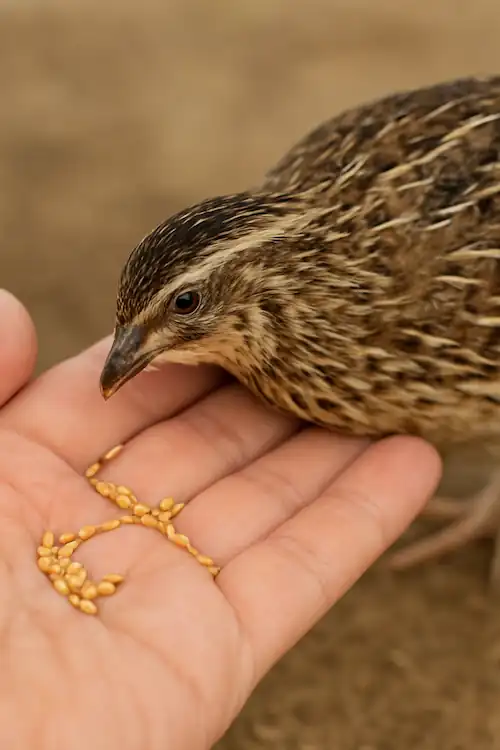
Quails spend most of their time on the ground. They scratch the soil for seeds, insects, and berries. You might also see them dust-bathing in dry dirt.
Most quails hang out in coveys, or small groups, when they are not breeding. The size and behavior of these groups can differ depending on the species.